Final Project: Exploring Masculinity

Nowadays, our society is surrounded by fights, violence, and intimidation. It is current to see more boys having those types of behaviours than girls. Men act in such a way, even though they are not good with it, because of their surroundings and the way society raised them. In this blog, the way society thinks, supports, and teaches men that success is important will be tackled, explaining where those kinds of behaviours are from and their effects on their lives.

First, society really does banalize fights. We think that because they are boys it is fine if they fight. We see fights as being a part of what a boy is supposed to be. “Masculinity is characterized by a willingness to take (physical) risks and become violent if necessary”1 Therefore, society goes with the mentality of “boys will be boys” and that fighting with each other is part of their development. School even goes till hiding how many fights happened in their institutions because for them, it is not an important enough problem, and they don’t want to deal with it. Even more, if boys refuse to fight, people won’t see them as real men, but rather as wimps who are scared to fight. Also, in other platforms such as hockey, people don’t consider hockey as a real sport if there is no fighting. Fights certainly do bring a feeling of manhood2 to the one who watches but also to the one who plays. Taking away fights will probably create a decrease in the number of people who watch it, thus, the incomes will decrease as well. Since people live for money, fights won’t be taken away from the NHL. In brief, since we expect boys to fight, we teach them that it is allowed, and it continues to be inhaled in our lifestyle and as they get older, they like being entertained by it too.

To continue, men don’t have access to a lot of moral support. Throughout their lives, men have been raised by learning that they shouldn’t express their emotions as well as their problems. “Further, they should solve problems without help, keep their feeling to themselves, and disdain any display of weakness.”3  Therefore, when men aren’t feeling cheerful in what they are doing, which is the case of the players who are hired to fight in the NHL, they don’t think they are allowed to talk about it and to ask for help before it gets too late. More, since the NHL assumes that their players are all real men, they assume that they don’t need to talk about how they feel, offering no support to their players. Therefore, the lack of support present in the NHL can explain why players reach a point where they think about committing suicide or even do it. However, as the NHL doesn’t want to deal with men’s problems, the players’ wife is the only one really present to help and support them. With the gender role we grew in because of institutions, women are seen as the supportive one and the one who should take care of the other.4 Thus, we assume that it is the woman responsibly to take care of how their man feel and to support him. Overall since men don’t have any resources and haven’t learned to talk about how they feel, it can lead to very big consequences.

Moreover, men have been taught since a young age that if they want to be a real man, they have to succeed in life. The achievements and the success they reach are pretty important for men, and they can be described by the amount of money they possess, the number of girls they are surrounded by, and by their job. Almost every little boy once dreams to play in the NHL, thus success for men can be described as reaching this level. Also, once they reached the NHL level, they have fans, money, girls, in other words, they have success. Therefore, they reach what little boys dream of, and at the same time, what men dream of. However, some of these players are only enrolled to give a show by fighting, and they are not truly happy with this. But if they want to keep their success they have to stay in the NHL. Consequently, they have to fight, otherwise, they will be kicked out of the NHL and subsequently lose everybody’s admiration. Due to the importance we accord to their status and achievement, players rather reach success by fighting than being mentally healthy. To sum up, fights in the NHL continue because no one opposed to them, not even the players because they want to keep their success.

To conclude, by imploring standards for men to follow, we put them in a position they don’t really want to be in, for example, fights. Society’s standards do affect the number of fights and violence we are surrounded by. To give a term to these acts of violence, we, the whole society, will have to stand up against it.


Kilmartin, Christopher, and Andrew P. Smiler. “Defining Men’s Studies.” The Masculine Self, Cornwall On Hudson, NY, Sloan Publishing, 2019, pp. 6.

Kimmel, Michael S. “Sexuality and Intimitate relationships.” Masculinity as Homophobia. 1994. 147.

Kilmartin, Christopher, and Andrew P. Smiler. “Defining Men’s Studies.” The Masculine Self, Cornwall On Hudson, NY, Sloan Publishing, 2019, pp. 7.

Kimmel, Michael.“Masculinity.” International Encyclopedia of the Social Sciences. Ed. William A. Darity, Jr. 2nd ed. Vol. 5. Detroit: Macmillan Reference USA, 2008. 1-5. Gale Virtual Reference Library. Web. 9 June 2014. pp.1-5.

Kilmartin, Christopher, and Andrew P. Smiler. “Defining Men’s Studies.” The Masculine Self, Cornwall On Hudson, NY, Sloan Publishing, 2019, pp. 7

Christopher Kilmartin and Andrew P. Smiler “Men at Work: Jobs, Careers and Masculinity.” The Masculine Self, Cornwall On Hudson, NY, Sloan Publishing, 2019, pp.221-235

Exploring Masculinity: Fighting, Concussions and Suicide in Hockey

On December 12th, 2008, Don Sanderson, a 21-year-old hockey player, was put into a coma and died after three weeks after he was in a fight at one of his games. His goal, from what he told his father, was that he did not want to fight, however, fighting is a part of the hockey culture. It’s a sport where the athletes get to show how strong, dominant and aggressive they are on the ice, pretty much how much of a “man” they are. Hockey is a violent sport; however, most hardcore fans will say that there is a “code” that everyone knows that makes the game safer. That code still falls under those stereotypical traits of masculinity.

First off, hockey is the only sport where fighting is allowed, and a lot of players, like Don Sanderson, did not want to fight. However, players are forced to fight to help out their teammates, such as George Laraque, the “enforcer” of his teams (Edmonton, Phoenix, Pittsburgh and Montreal). Laraque explains that his role in the team was to make sure that his teammates were safe. According to Kilmartin’s text “No Man is an Island: Men in Relationships”, instead of complimenting each other and saying meaningful stuff, men will often show friendship by helping each other out (Kilmartin: No Man is an Island: Men in Relationships). Moreover, CBC tells the viewers, in their episode “The Code”, that protecting your teammates is “the essence of hockey’s unwritten law”, and in the case of Don Sanderson, the only reason why Don would fight was to help his teammates. After his first games, Don called his dad and told him that he got into a fight, and when he was asked why, Don said that he was helping out his captain and that his captain was more important to the team. Some of these “kinship” rules can also be seen in places like the schoolyard, where some boys would be excluded from a group for not helping their friends, or not fighting alongside the group. In sum, most of the time, when players who don’t want to fight to end up fighting, is to protect their friends and teammates, which is how men make “real men” make friends.

For Don Cherry, the code is to fight with honour, which can relate to Brannon’s four themes of masculinity. The first one, “Antifemininity”, refers to men avoiding feminine traits (Kilmartin: Defining Men’s Studies). Furthermore, what I learned in Anthropology when A roman gladiator fought with no fear of death, the crowd would consider that honour. Therefore, in this hockey context, I would assume that fighting with no fear would be considered “fighting with honour”. The second one, “Status and Achievement”, is pretty self-explanatory, the man has to be successful in whatever he is doing, which would mostly be sports, work, and/or sexual “conquest” (Kilmartin: Defining Men’s Studies) In hockey, those who are more successful are those who win more fights. Furthermore, a lot of hockey players are in the NHL for their fighting ability rather than their hockey skills. The third element, “Inexpressiveness and Independence”, describes a man to be strong no matter what and should not depend on others in any situation (Kilmartin: Defining Men’s Studies). Strength can be measured in many forms such as physical (muscles or stamina) or mental (Strength od character, dedication, or stubbornness), and in hockey, it would mostly be the players that have the most strength, physically and mentally, who are the most recognized in a team. Lastly, the fourth element, “Adventurousness, and Aggressiveness”, explains that men should be willing to take physical risks and have the ability to be aggressive when they have to be (Kilmartin: Defining Men’s Studies). Taking physical risks and being aggressive is something you need in all sport, you always have to push the distance of your physical ability to achieve greatness and, during games, you need to be aggressive so that you can use the full extent of your body and muscles. In sum, Don Cherry’s definition of The Code can fit the terms of Robert Brannon’s “manbox”,

Finally, some players are not in the NHL because of their skills on the ice, but rather their fighting abilities. As most fans and players will tell others, fighting is a big part of hockey, and according to Jon Mirasty, hockey without fighting is just figure-skating. In Kimmel’s text “Masculinity as Homophobia” it states that violence is a big marker of manhood (Kimmel: Masculinity as Homophobia), which would usually lead to people thinking that the person has an aggressive and daring personality. This is a tactic that some teams use in the league, instead of scaring the other team by having good plays and winning all the time, they make sure that the players are big and strong and can hit very hard. According to Nick Kypreos, hockey is based on intimidation, which comes back to Kimmel’s text saying that manhood is associated with power (Kimmel: Masculinity as Homophobia). In the hockey context, using intimidation to make the other team fear them lets them have power over the other team and allows them to control the game even more. The intimidation tactic can and will also be let the fans and the other team know who the dominant team is. In sum, certain aspects of manhood is also used as a tactic to make the game a little easier from one of the two teams on the ice.

In conclusion, even if hockey those have a lot of fights, you can’t just yank it out of the sport, since it might lead to more malicious tackles between players. I am not saying that The Code is making the game safer, and I am not saying that it is not, because I don’t enjoy watching fighting in sport. Of course, taking out fights may cause you to lose fans and money, since Don Cherry pointed out, 70% of the people associated with hockey enjoy the fights. One way I could think of to solve the issue at hand is to teach the young kids to not do that since athletes mostly remember the aspects they learned when they were young. However, to have that big of an impact, you will need to have a whole new generation of hockey players, and there is also the problem of the NHL losing money. Therefore, taking fighting out of hockey is a hard decision to make.

Reference:

Exploring Masculinity: Fighting, Concussions and Suicide in Hockey

INTRO

Hockey is a sport for the cultural man, because it’s a stage for men to show off their dominance, strength, aggressiveness and competitiveness so they can show everyone who the strongest is.

The cultural man is defined as strong, dominant, tough, aggressive, physical, competitive and forceful which are all adjectives that that describes what hockey fans think you need as a hockey player. Things that you need to be able to do as a man: takes action, protects women and children, gets the job done, takes risks (Kilmartin, Defining Men’s studies). Also, physical risk-taking is one of the negative aspects of today’s masculinity (Kilmartin, Men at Work: Jobs, Careers, and Masculinity). Nick Kypreos said in “The Code”, the hockey documentary that, he himself dropped his gloves and fought just to show that he still a tough guy and physical force. Also, they say in the documentary that teams use this method in order intimidate other teams and win games.

Toughest Hockey Players in NHL History | Stadium Talk

“There is a deep tension between intimacy and masculinity. He wants both, and each seems to be purchased at the price of the other”’ (Kilmartin, No man is an Island: Men in relationships). This causes them to not be open about certain things in their life, such as the negative suicidal thoughts that hockey players feel due to the fighting and concussions on the ice like the hockey player Todd Ewen or Wade Belak. This is why men should feel more open about their feelings and share it with others so their close ones can help. Moreover, “[…] he may find it very difficult to “flip the switch” that turns on all of  the emotional and relationship attitudes that he has suppressed all day at work” (Kilmartin, Masculinity). In other words, at work, which in this case is ice hockey, they contain all their emotions and act like another person so, when arrived at home, they find it not only physically challenging to spend some quality time with their family, but also mentally challenging because they know they spent the whole day being aggressive on the ice with other players. This was something that some players wholeheartedly hated doing just like Todd Ewen who told his wife that.

Why Am I Always Tired ? - CPAP sleep study test, equipment, supplies

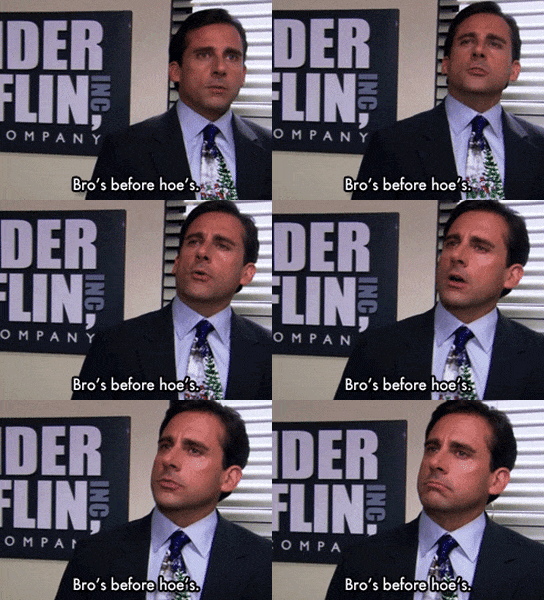
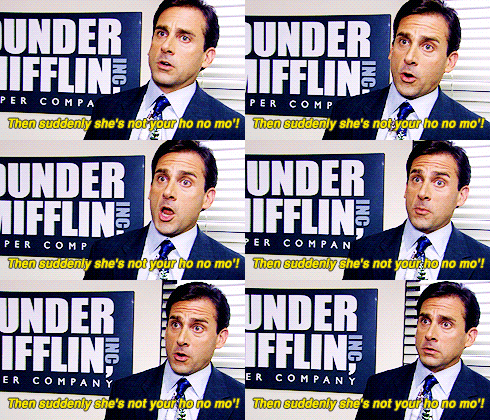
The code in hockey is similar to the bro code that young adult boys respect nowadays. It’s a “principle” that basically states that you put your boy friends before girls as a guy or a man. In hockey, it states things like don’t body check with your stick or to take off your helmet when fighting another hockey player to protect his hands. “What it means to be a man varies in different institutional contexts, and those different institutional contexts demand and produce different forms of masculinity”.  This means that just like the bro code, the hockey code is also an institution that forces some of these men to participate and practice this code, meaning that they feel obliged to fight because everyone else is doing it and telling them to do so. “Boys may be boys, […] but they express that identity differently in fraternity parties than in job interviews with a female manager” (Kilmartin, Masculinity). This also means that similar to movies, they show how the man respects the bro code when they are with their girlfriend and they just leave her even if they didn’t want to because his “boys” are here even though he would prefer to stay with her. It’s almost as they flip a switch that transforms how they act. I for one have seen this happen with one of my friends whenever we arrived as a group and saw him with his girlfriend at school for example. Not often of course, because we’re the type of friends that leave couples in the friend group some space.

The Office Television GIF - Find & Share on GIPHY
Bros before hoes television the office GIF on GIFER - by Nilathris
The Office Ho GIF - Find & Share on GIPHY

CONCLUSION

All things considered, these hockey players are no different from other “average” men who suffer from emotional suppression, respecting the cultural man norms, and feeling like they have no one to go and develop some suicidal thoughts. This means that despite the fact that these hockey players are around other people such as their teammates and coach, they can still feel lonely, unlike office workers, for example, who spend the big majority of their time only working with numbers on paperwork in front of a computer and not actually talking to anyone.  

Works Cited

Kilmartin, Christopher. “Defining Men’s studies.” (n.d.): 1-7.

—. “Masculinity.” (n.d.): 1-5.

—. “Men at Work: Jobs, Careers, and Masculinity.” (n.d.): 221-235.

—. “No man is an Island: Men in relationships.” (n.d.): 161-171.