Final Project: The consequences of fighting in Hockey – Annie Varvarikos

Throughout the years the consequences of fighting in NHL hockey and the true severity of recurrent head trauma have started coming to light. We saw this in two assigned documentaries done by the fifth estate, “The Code” and “Wives reveal”. “The Code” was basically an introduction to the main issues, and the “Wives reveal” was a slightly more in depth look into NGL related deaths and the families experience. It has also come to light that often the players who are responsible for fighting don’t really understand what they’re getting into. These men are also only hired to fight. We also saw a huge internal struggle within the NHL itself, with many people for fighting in hockey and of course the people who were against it. But with the staggering number of serious head trauma and the later repercussions, it’s a wonder why fighting in hockey hasn’t been completely banned all together. Especially considering it has been linked to a number of deaths, including both on the ice and suicide. Personally I picked up on aspects very old school and unhealthy ideas of masculinity in this situation.

Enforcers, tough guys, heavy weights, goons. These are the men expected to fight in the NHL. According to one of the hockey reporters from the documentary “The Code” there are 60 NHL jobs reserved for enforcers, and while they’re definitely physically gifted and athletes in general, they’re not technically hockey players by trade, according to one of the reporters interviewed in “The Code”. Or sometimes they accept those positions in the league because they know it’s the only way for them to get into and stay in the NHL. This continuous fighting for so many of these players have resulted in multiple sever concussions. Shockingly enough most of which are undocumented, as was the case with former enforcer Wade Belak . Injuries such as these can lead to other more serious issues. The most common and the biggest issue being CTE; Chronic Traumatic Encephalopathy, which is caused by recurrent head trauma, such as the concussions many NHL players suffer from. It results in symptoms such as mental health issues (anxiety, depression, memory loss, bursts of confusion) substance abuse and even suicide which was sadly the case with Wade Belak (pictured below)

Wade Belak

But where do those ideas of old school masculinity come in though as mentioned beforehand? I for one saw a lot of it when they further discussed the effects of CTE in the “Wives Reveal” documentary by The Fifth Estate. There is and has always been a stigma around mental health in general. However there’s an incredibly huge stigma around mental health in men because its seen as weak, soft and not at all masculine. Which heavily ties into the ideas of toxic masculinity because it all about being seen as strong, independent, and stoic, with common ideas such as the bro code, and that athleticism is very important, which is why a lot of athletes suffer from being put into the “max box”. Which was further discussed in the documentaries we watched in class and class discussions. Because the main symptoms of CTE are mental health issues it’s no wonder nobody wants to officially dress it even when it’s (unofficially) leading to a rising number of deaths in NHL players. The players obviously dont want to be seen as weak, and with the sport being such a huge industry the people behind everything dont want to let on the players are having difficulties for fear of loosing money.

On that note, money and the economic part of the NHL bring a whole other aspect of toxic masculinity into the argument, and really engrains it in all parts of the industry instead of just with the players. Earlier in the semester our class watched another documentary called “The Mask you Live in” there was a lot of in depth explanation as to what toxic masculinity is and what it entails. This documentary touched slightly on economics, and was mentioned again during our in class discussions. Masculinity is often attached to financial success which ties the industry further into the issue and gives us another reason to say the big time wealthy NHL hockey players are victimes of the “man box”.
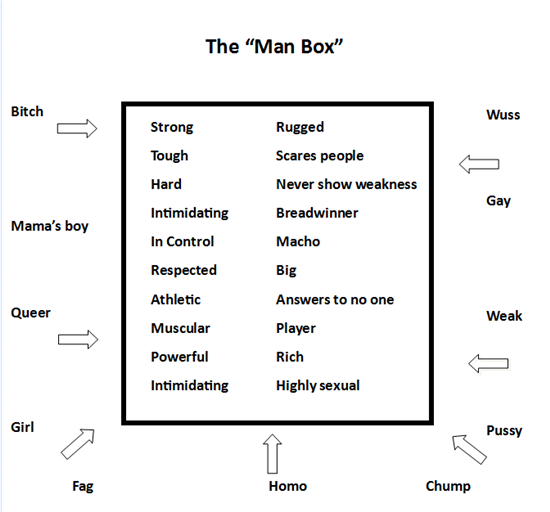
Men and Masculinities | Women and Gender Advocacy Center

I think another big part of the ideas of masculinity probably comes in the form of “I am big strong man I must fight to prove it” thought process. Which definitely involves fear to some degree and definitely stress which is doubly awful on top the possible mental illness already caused by CTE. According to former enforcer Nick Cypryos he and fellow enforcers alike always experienced a pregame feeling of dread knowing the predicament they’d probably be put in at some point on the ice, even going as far as to say ” you’re fighting for your life a lot of the time.” Hearing Cypryos talk in the Fifth Estate’s “The Code” was eye to opening to the truly damaging about of stress the players are under a lot of the time. Not to mention the fights themselves, Cypryos himself lost his career to injuries sustained from a fight. In other more serious cases such as with Don Sanderson, who died on the ice.

The Morning After: Seg. 2 - Nick Kypreos on Blues-Stars ...
Nick Cypryos
Hockey player dies after fight | Toronto Star
Don Sanderson, his jersey now hangs in the arena where he died

Fighting makes hockey Stereotypically more masculine “Without fighting you just have figure skating on ice” says one of the minor league players. This is another area we can tie into the general theme of masculinity because figure skating is (typically) very feminine and here there’s obviously a need to pull away from that. On top of everything else it seems one of the up and coming issues of fighting in hockey is that it’s becoming a legacy. Despite proof of long term negative effects fighting is becoming a major issue in the minor leagues. Even in children’s games too as seen here in the YouTube video titled “Police Investigating Youth Hockey Brawl” https://www.youtube.com/watch?v=bxNTOqowq3w. Or of course the fight that made national news in 2007, “Ice Hockey – 8 yrs old fighting brawl ice hockey Ontario.” https://www.youtube.com/watch?v=mhZ_PC0CLec. Where teams aged only 8 years old got into a huge fight. They’re taught they need to be strong and violent and stereotypically masculine, this (seen in the videos above) starts at a very young age. Which was an idea also discussed in one of the first readings we had to do in our class “Lovers and Fighters” a memoire written by Carlos Gomez detailing his (near) life long struggle dealing with his idea of his own masculinity.

Unfortunately, despite all of these issues most fans and people within the industry don’t want fighting taken out of hockey. According to former player and then reporter Don Cherry, 70% of people involved are pro fighting. Nick Cypryos himself said that it although it needs to be regulated more it shouldn’t be completely taken out. Personally I think that if the NHL can take responsibility for the impact it has on the players and make sure they know what they’re getting into and have a much better way to regulate fighting they should be free to do whatever they want.

Blog 5: Friends

The person I interviewed for this blog post doesn’t actually have one singular best friend, but a group of around 8-9 nine individuals. Although Based on the assigned reading it seems that the interactions between the group members doesn’t whole heartedly fit into the “Man Box” my interviewee did say that they almost never hang out one on one with each other and that when they all get together its generally around 4 individuals at least. This one aspect can be seen to fit the stereotype to a certain degree.

The person I chose to interview for this blog post claims to be close with his current friend group for multiple reasons. They all share a similar type of humour and have been able to forge many inside jokes and relate them back to memories because of it, which has helped to strengthen the bond between them all. The group of them have known each other for many years and being young adults now, they’ve basically grown up together. They’ve all gone through some kind of hardship while knowing one another and have all been able to “band together as bros” and help each other out. The bond between them seems more than solid.

Contrary to what the text suggests the group of guys don’t actually have specific activities they do together. Generally they’re more than content to drive around town listening to music or hang out at each others houses. As the kids say these days the boys do #turnup however in comparison to most stereotypes they are generally a very laid back group.

Their relationships in regard to (verbal) affection are rather interesting though. For example they show no fear posting a snapchat story for each other birthdays with a heart emoji and saying “I love you man, I hope you have a blessed day”. But my interviewee seemed a little weirded out when I asked him if things like that were ever said face to face, “um well sometimes I guess, thats not stuff we really say though. Even though we feel it, we all just kinda know we do.” Was what he awkwardly stammered.

Blog 4: Man enough?

By saying that institutions accomplish the creation of gender. Kimmel is referring to the way we’ve organized society and in this case work or school environments to favour old time gender roles. If there is a stay at home parent present in the home it is often more beneficial for it to the the woman just because of how society is arranged.

What Kimmel means by the plural “masculinities” are both the cultural differences associated with the ideal man, and also the differences in different time periods. For example a white middle class man in the 50’s would have a different idea of what it means to be “a man” than a young boy in todays day and age. But both examples are still affected by the social pressure and unfair constrictions of what we’ve excepted as being a “man”. By saying “Masculinities” we are understanding and including certain discrepancies within the meaning.

Blog 3: Anti Femininity

Trump takes shot after guilty plea: 'Don't retain the ...

Donald J Trump is a perfect example of anti-femininity. He continuously is known to over sexualize women and chalk them up to the mindless caricatures of makeup and boobs that the toxic masculine thought process has conditioned us to believe. Famously saying “Just grab em by the pussy” completely ignoring the concept of consent and barley acknowledging the humanity in women. He seems to believe he can get whatever he wants out of women because of his wealth and status. Exampled by also referring to Unfortunately this has also lead to him getting away with so many very inappropriate comments and actions, and as the president of the United States this has had disastrous effects on the country.

The US president has made his homophobic veil point very clear in his actions. He has removed LGBTQIA+ anti-discrimination and protection laws/bills for students and workers. He also removed mention of their rights from the white house government website. Last but not least Donald Trump tried to ban transgender people from serving in the military, stating that the extra medical care they would need would be too expensive. However, after the amount was calculated it was found out that the US military spends more than double the amount needed to properly accommodate transgender soldiers, on viagra. This culture and the toxically masculine viewpoint held by Trump doesn’t value what we’ve feminized. Homosexuality, especially in men is hyper feminized and often people who hold a toxic masculine thought process will feel the need to distance themselves from people who are LGBT. But Donald Trump is on a whole other level and has been able to take out his feelings on so many innocent people.

Trump has been able to take his anti-femininity out on women directly as well. He supported Alabama’s abortion ban. This ban did not allow anyone with a female reproductive system to get an abortion under any circumstances, including rape, incest and even if someone not identifying as a girl decides he/they cannot psychologically go through a pregnancy.

Donald Trump consistently expressed anti femininity ideas and thought processes throughout his life and not only in the media.

Blog 2: Becoming a “Man”

The pieces of info in the documentary that really jumped out at me were the few things I didn’t know before I watched it, or just hadn’t made the connection. We often think about how toxic masculinity has effected women and how it plays into/opposes feminism, but as a society we regularly neglect how it’s negatively effected boys and men. The idea of toxic masculinity stems from the idea that men are bigger, smarter and stronger than others, including each other. This creates unhealthy actions, habits and responses specifically in young men. The stress of needing to constantly perform or the psychological repercussions of not feeling like they’re enough or not being allowed to do certain things. It’s a thought process which has lead to 1/4 of boys to report being bullied due to this kind of mindset, and those are only based on the reported cases. Or that something as simple as crying is so looked down upon. When in reality crying is actually quite healthy, it releases endorphins in your brain and acts as a stress/tension release, yet we shame young boys for crying. It is also due to this thought process and perpetuation of it that has made suicide is the third leading cause of death in young men.

I saw a few similarities between the documentary and Carlos Gomez’s book, the first being to shy away anything culture has feminized. This is because as a society we tend to view women as “weak” and men as “strong”. Because of this there often a need for a “mans man” to distance himself from anything we have deemed feminine because then (in his mind) he is viewed as weak.

Annie Varvarikos

Men Who Inspire – Annie Varvarikos

One of the men who inspires me is a man named Kevin Richardson, also coined by media as “The Lion Whisperer”. Kevin owns a private wildlife park just north of Johannesburg in South Africa, here he cares for and incredibly interacts with lions, hyenas, and leopards among other animals. The goal of the “Kevin Richardson Wildlife Sanctuary” is conservation through education. Kevin runs a YouTube channel and other social media pages which highlight his unique relationship with the animals and aims to show the world they are more than mindless killers. With drastic and fast decline in numbers of wild animals (such as the ones he cares for), conservation efforts are more important than ever. While work like Kevins is rarely easy, he’s stuck with his views and career through thick and thin and has done so much in the way of creating awareness with his social media pages and through public speaking. Kevin is someone I find very inspirational because he is very dedicated to the amazing work he does. I’ve been following his YouTube channel since I was around 11/12, since then I’ve grown up with not only a love of animals but a deep respect for them and for people like Kevin. I’d even venture to say that seeing this kind of work being done had an influence on my decision to go study environmental sciences.

Among all of these things I’ve used to describe Kevin some other attributes commonly shared by other people who inspire me include: Down to earth, self assuredness, dedicated, and intelligent.

>Kevin-Richardson -The-Lion-Whisperer | Blog Marketing