Final Project: Hockey Fights and Masculinity

“Oh, Canada”. Much like the national anthem, hockey has been a national emblem for as far as Canadians can remember. It has shaped the dreams of many little boys, who traded hockey cards and dreamt to one day proudly stand in the Bell Center, playing for their favorite NHL team. However, behind the glorious wins and the emotional games, come hockey fights, and with those come injuries, mental illness, and even death. Looking at this issue from a “masculinity” perspective makes it easier to see that these fights and their negative impacts on players’ lives are, in fact, a product of society’s rules of manhood. More particularly, the strong effect hockey fights have on a player’s career, family and mental health are all linked to what we, as a society, define to be masculine.

         For starters, how does society’s definition of masculinity normalize hockey fights? An important aspect of men’s masculinity is “status and achievement” (Kilmartin and Smiler, “Defining Men’s Studies” 5) which is why men feel pressured to be ambitious and always strive to reach the top. Another major component is the “willingness to take risks and become violent if necessary” (Kilmartin and Smiler, “Defining Men’s Studies” 6). This explains why many men have accepted to be the fighters in their hockey teams. According to The Code, a documentary about hockey fights done by CBC’s The Fifth Estate, there are about “60 jobs in the NHL for guys who can’t play, but can fight”, referred to as enforcers (The Fifth Estate, “The Code”, 35:50-35:58). Their job is surprisingly, not to play the sport, but to provide protection to their teammates on the ice by engaging in fights. This gives them the high status and sense of success that comes with being an NHL player, and allows them to constantly display how “tough” and aggressive they are. This shows why hockey fights were not regulated for a long time; they correlated well with society’s expectations towards men so they were considered as a normal part of the game. According to the report, some even consider hockey a sport “based on intimidation.” (The Fifth Estate, “The Code”, 25:40-25:50). Thus, it is clear that the NHL would use these components of masculinity that are widely accepted by society to normalize the hockey fights and make them part of the entertainment.

      Now that we understand better why these fights were commonly accepted for such a long time, it is interesting to link the consequences of these fights to masculinity. For one, society’s rules of manhood encourage hockey fights, negatively impacting men’s careers in the NHL. Take former enforcer Nick Kypreos, for example, who wanted to show how tough and aggressive he was by engaging in a violent hockey fight. He ended up not only losing the fight, but also his career due to serious injury. While these heavyweights are praised for their aggressiveness, enforcer Marty McSorely also lost his career in the NHL for living by this code and inflicting too great of an injury to an opponent player (The Fifth Estate, “The Code”, 18:08-19:07, 25:53-27:08). Yet, these two are still considered lucky. What about Don Sanderson, who lost his life on the ice rink because of a fight? Part of the problem is that this pro-fights mentality is so deeply rooted into many “hockey people.” For example, enforcer Jon Mirasty, also known as Nasty Mirasty for his excessive violence, even said that hockey without fighting is “figure-skating on ice”  (The Fifth Estate, “The Code”, 21:32-21:45). Had it not been in the rules of manhood to be antifeminine (Kilmartin and Smiler, Defining Men’s Studies 5), there would be no shame in comparing hockey to a more “female dominated” sport such as figure skating. If society’s definition of masculinity did not expect men to be, as stated earlier, intimidating and aggressive, hockey fights would have been banned a long time ago and these players would probably have had more time to play their favorite sport. In short, hockey and fights are only inseparable because of the masculinity pushing players to be aggressive and do anything to be at the top of the game, and most of the time they end up having shorter careers because they either inflicted or received a too harsh injury, or even worse, died on the ice. 

Society’s rules of manhood also play a role in the mental health issues resulting from hockey fights. Hockey players are taught to take off their helmets in a fight, because it can lead to a variety of hand injuries (The Fifth Estate, “The Code”, 23:27-23:50) – but what about protecting the head? Clearly, it seems that men do not need their head to perform the fighting, only their hands. Maybe had their heads been better protected, many hockey players would not have suffered concussions and later on, CTE (Chronic Traumatic Encephalopathy). Another documentary by The Fifth Estate provides several examples of players, such as Todd Ewen and Wade Belak who lost their lives due to depression and substance abuse caused by CTE, a disease that is very common with athletes. The problem is, this disease can only be diagnosed in an autopsy, meaning most ex-players do not even know about it, and keep having mood swings and losing control of their brain without an explanation (The Fifth Estate, “Hockey Fights: wives reveal the cost of the concussions” 13:00-13:50) . For example, according to Todd Ewen’s wife, Kelli, “one day [they] had the sad Todd, the mad Todd, the angry Todd” (The Fifth Estate,“Hockey Fights: wives reveal the cost of the concussions” 12:26-12:37), and because they did not make the link with CTE, Ewen always felt like he was losing his mind and suffered for years from not knowing what was wrong. In fact, one of the main components of masculinity is “inexpressiveness and independence”, which pressures men into being “independent and in control of themselves, even in the toughest situations” (Kilmartin and Smiler, Defining Men’s Studies 5). Research also shows that “when they are hurt, men are less likely than women to seek medical help” (qtd. In Kilmartin and Smiler, “Jobs, Careers and Masculinity” 232). This component of masculinity pushes players not to seek help when they are feeling depressed. Moreover, it is harder for them to talk about their emotions and mental health, because they have a “limited emotional vocabulary and framework” (Kilmartin and Smiler, “Fathers and Fathering” 186), and this can be very dangerous as seen with Belak and Ewen. Thus, masculinity is not only reinforcing hockey fights, it is also making their consequences much worse and much more dangerous when it comes to men’s mental health.

Three hockey enforcers die young in four months, raising questions ...
Three hockey enforcers (including Wade Belak) who died surprisingly young in the summer of 2011. According to CNN and to The Fifth Estate’s 2019 documentary, the three have had problems with substance abuse and depression. Source: CNN, http://edition.cnn.com/2011/SPORT/09/01/nhl.enforcers.deaths/index.html

Masculine studies can also help to better understand the consequences of hockey fights on the player’s family relationships. A hockey player may also be both a husband and a loving father, and with this brain injury he often struggles to connect with his loved ones. Both documentaries displayed several players whose family had to go through the terrifying experience of seeing them fight and hope that it does not end badly. As for players who, ten years later, start noticing the symptoms of CTE, they exhibit several behavioral problems that their wives often have to deal with and they struggle to bond with their children. For example, CBC’s documentary talks about Daniel Carcillo, who according to his wife “was always at home” while she was always taking the kids out. She also said that “he just didn’t want to connect with anyone, and sometimes that was with [her] too” (The Fifth Estate, “Hockey Fights: wives reveal the cost of the concussions” 1:25-1:57). For those who have taken their own lives, they have left their families broken. Some kids will grow up without a father, and according to Kilmartin and Smiler, “the quality of the adult son’s relationship with his father was significantly associated with the son’s level of mental health.” A father’s absence, even if it is simply an emotional absence like with Carcillo, has a strong impact on the children, particularly young boys. It also does “appear to have a lasting impact on men’s understanding of themselves and of their lives.” (qtd. Kilmartin and Smiler, “Fathers and Fathering 192). Luckily, Carcillo has made significant efforts to better himself and to connect more with his children, but we can also think of Wade Belak’s daughter, who wishes he could be there watching her games, “giving [her] a hug after a game, or high-fiving [her]” (The Fifth Estate, “Hockey Fights: wives reveal the cost of the concussions” 19:30-19:43). In short, masculinity in hockey fights takes away fathers from their families, consequently affecting the families as well.

Toxic masculinity clearly had its toll on the NHL’s attitudes concerning hockey fights. This shortens many players’ impressive careers, negatively impacts their mental health, and destroys their families in the process. However, as my own mother is a big hockey fan, I have witnessed the awareness about these fights grow, as the rules now are much more strict than they used to be. As the definition of masculinity is changing nowadays and becoming more inclusive, we might want to slow down the next time we hear “Oh, Canada!” in the beginning of a hockey match and consider what hockey we want to pass down to the next generation – an exciting game, or a suicide mission?

Works Cited
Kilmartin, Christopher, and Andrew P. Smiler. “Defining Men’s Studies.” The ` Masculine Self, Cornwall On Hudson, NY, Sloan Publishing, 2019, pp. 1–7. 

Christopher Kilmartin and Andrew P. Smiler. “Fathers and Fathering.” The Masculine Self, Cornwall On Hudson, NY, Sloan Publishing, 2019, pp. 180-182,185-195–171.

Christopher Kilmartin and Andrew P. Smiler. “Men at Work: Jobs, Careers and Masculinity.” The Masculine Self, Cornwall On Hudson, NY, Sloan Publishing, 2019, pp. 221-226, 228–235. 

The Code. Directed by Oleh J. Rumak, The Fifth Estate, 2010. CBC/Radio-Canada. https://www.cbc.ca/fifth/episodes/2009-2010/the-code

Hockey fight: Wives reveal the cost of concussions. Directed by Virginia Smart, The Fifth Estate, 2019. CBC/Radio-Canada. https://www.cbc.ca/fifth/episodes/2019-2020/hockey-fight-wives-reveal-the-cost-of-concussions

Cohen, Tom. “Three Hockey Enforcers Die Young in Four Months, Raising Questions.” CNN, Cable News Network, 1 Sept. 2011, edition.cnn.com/2011/SPORT/09/01/nhl.enforcers.deaths/index.html.

Blog 6: International Women’s Week

I attended on Tuesday a very interesting talk by Jay Marquis-Manicom about his thesis, “From the Red Pill to ‘White Genocide’”, in which the speaker discussed the links between the Alt-Right movement and the Red Pill. Through the talk, he explained how members of the Alt-Right, a far-right white supremacist movement, are often also involved in online male supremacy by taking part in websites such as The Red Pill. Many aspects in this talk stood out to me.

First, in his talk Jay told his audience about The Red Pill, a website where men share tricks on how to get women to sleep with them. He explained that on these websites, men consider women biologically inferior. This is, however, not unique to men who have “taken the Red Pill”. In fact, one of the most important components of stereotypical masculinity and fitting in the man box is to not behave “like a girl”, which includes not showing emotion or any sign of weakness. Showing weakness and vulnerability is unmanly because it is considered a feminine trait, which means that several men view women as being weak. This idea is supported by Christopher Kilmartin and Andrew P Smiler’s work, “Defining Men’s Studies”, which states that “males are encouraged from an early age to avoid behaviors, interests and personality traits that are considered ‘feminine’. Accordingly, men are directed to not show emotion, sometimes referred to as “emotional stoicism”, because emotion is often considered as a central and defining characteristic of femininity (Bem, 1974; Spence and Helmreich, 1978)” (Kilmartin & Smiler 5). Therefore, men who have taken the Red Pill consider women to be weaker for expressing emotion and use this superiority to validate their masculinity.

Another interesting aspect of the talk was the philosophical component that links male supremacists who have taken the Red Pill to Alt-righters. Indeed, these people believe, among other things, that masculinity is in crisis and that “men aren’t men anymore”. But what does it mean to be a man? For these people, it includes as mentioned earlier being superior to women. Jay even said that it would be the end of the world for them if women had equal rights. Furthermore, based on their past as pick-up artists and the goal of websites such as “The Red Pill”, it is safe to assume that being a man, for these people, has got to do with sleeping with many women, or, as referred to on page 5 of Christopher Kilmartin and Andrew P Smiler’s work “Defining Men’s Studies”, “sexual ‘conquest’”. By sleeping with many women, men achieve this “sexual ‘conquest’” and obey to what society considers to be masculine. In fact, Kilmartin and Smiler even suggest, in that same work, that “The combination of Antifemininity and Status and Achievement support the notion that men are inherently superior to women, and thus can be seen as justifications for sexism”(Kilmartin & Smiler 5), which links this paragraph to the previous one: these men believe that women are inferior to them, meaning they are weaker and can be manipulated easily to have sex with men, giving men more sexual conquest and making them more manly.

Lastly, another moment that stood out to me was when the speaker was talking about the demographics of the alt-right movement. He stated that it is dominated by millennial men, which made me think about what it is in women that doesn’t drive them towards so much violence. This can be explained by women’s stronger ability to communicate their feelings, which leads them to resort less to drastic measures and violence. As stated on page 166 of “No Man Is an Island: Men in Relationships” by Kilmartin and Smiler, masculinity “directs men to avoid sharing feelings. Even when they do, their upbringing shortchanges them”, meaning their relationships are less intimate. The same work reported, also on page 166, that men who do have intimate relationships (which goes against what masculinity dictates) report less violence. This goes to show that these men, who want to be viewed as strong, virile and enlightened will clearly not communicate emotion and have violent tendencies such as the alt-right movement. To conclude, understanding masculinity is important if we want to understand the roots of movements such as the Red Pill and the Alt Right. As Jay Marquis-Manicom said himself, understanding the movement is the only way to dismantle it.

Blog 5: Friends

When interviewing a male friend about their male best friend, I noticed many links between these men’s relationship and Kilmartin and Smiler’s work. When I asked my friend why they were so close to their best friend, they couldn’t immediately answer me. They told me this question was a hard one and then said that they became friends through playing football together. Clearly, this answer shows that their friendship is very activity-oriented. Indeed, they became friends through a common activity and became close through being on the same football team. This correlates to the theory presented in Kilmartin and Smiler’s work, which states that “male-only groups are often more activity based” (Kilmartin and Smiler 169). Studies prove that male friendships revolve more around activity, which is obviously the case here.

I also asked my friend about the kinds of things he likes to do with his best friend. He told me that it’s almost never just the two of them, they’re often hanging out as a group, mostly playing cards. This, again, relates to the theory presented in “No Man is an Island: Men in Relationships”. Indeed, these boys are clearly very activity-based, since my friend insisted on him and his friends almost always sitting around a deck of cards and playing a card game. The fact that his best friend and him almost never hang out alone also stood out to me and made me think about how other men I knew around me also tend to hang out in groups, again always “with the boys”. Moreover, I noticed that the activities that they do together do, in fact, involve some conversation. Besides playing cards, my interviewee told me that they sometimes go out to eat, or “just hang out”, which isn’t as activity-based and is obviously more conversation-involved.

Lastly, I asked my male friend if he has ever told his best friend how much he means to him. After some hesitation, he told me that he has told his best friend a few times that he appreciates him, but that his best friend is not “that kind of guy” and would tell him to “not be weird”. This, again, is very common among male-male friendships according to Kilmartin and Smiler. As stated on page 170, “the expression of closeness between men often takes the form of continuing to spend time with each other and helping each other with tasks weather than more direct expressions such as touching, or saying “I like you””. It is also suggested that boys have a harder time dealing with emotion, since they have always been taught to keep it all in, which explains why some boys might feel that their friendships aren’t very intimate. While I cannot assume anything about the relationship between my interviewee and their best friend, it is proven by many studies presented in “No Man is an Island” by Kilmartin and Smiler that many boys don’t know how to express their feelings and feel, therefore, like their relationships lack intimacy.

Blog 4: Man Enough?

Michael Kimmel’s essays about masculinity have questioned our definitions of this term and study several aspects of society. On page 3 of Michael Kimmel’s “Masculinity”, he states that “Institutions accomplish the creation of gender difference and the reproduction of gender order through several gendered processes” (Kimmel 3). By this, he means that social institutions, such as religion, family and the workplace, are associated to masculine or feminine traits and they contribute to defining gender. Since these institutions attribute roles to men and women from the start, they contribute to our common definition of masculinity and femininity. For example, most common religions in the west are based around patriarchy. Therefore, it is only normal to define men as the “bread winners” and the ones who hold power. Through these institutions, the difference between the two genders is more clearly perceived and more predominant in society. They contribute to the stereotypes concerning men and women are therefore more present in society since a very early age. In the fourth episode of “Man Enough”, it is stated that boys are taught from a very young age that they have power and dominance over women. In the institutions we have established in our everyday lives (workplace, religion, family), women have less power. Boys are therefore taught to be misogynistic and grow up with fictional rules of manhood that have been dictated to them by society’s institutions.

Kimmel also constantly uses the term “masculinities”. By this term, Kimmel refers to the presence of several definitions of masculinity. He states in his work that masculinity doesn’t have one universal definition, rather it varies according to the time, place, and interactions someone was brought up with. He states, in his work, that “an older, black, gay man in Chicago and a young, white, heterosexual farm boy in Iowa would likely have different ideas of masculinity” (Kimmel 2). Kimmel prefers using this term because he finds it liberating. It is a reminder to all men that their masculinities are not fixed identities, defined or assigned to them from birth. Rather, they are a product of their upbringing and can change even within a whole society. In the fourth episode of “Man Enough”, it is stated that 80% of men don’t know what consent is. Even though 1/6 men are raped, men are not trained to deal and process such horrific events. A man’s masculinity is questioned when he gets assaulted. Therefore, by understanding what messages are being subconsciously transmitted to men through their interactions in society, we can make sure these messages include better definitions of masculinity, with less violence, more love and more listening. By understanding what messages are being subconsciously sent to boys on how to be a man, we can deconstruct the “man box” that is mentioned in the documentary and ensure that we live in a better society for all genders.

Blog 3: In-expressiveness and independence

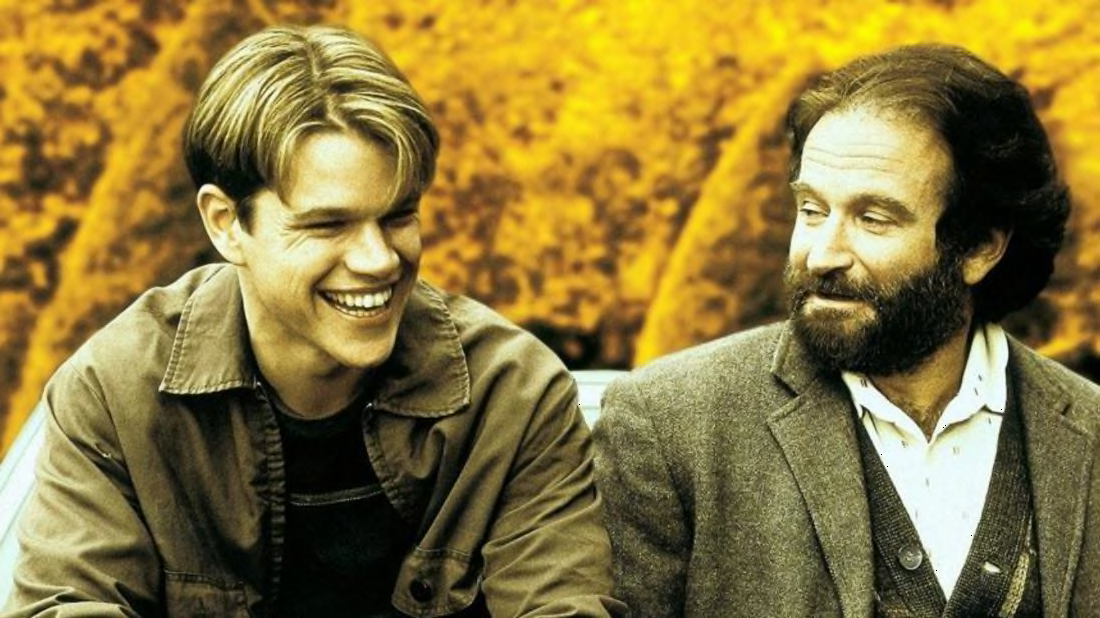
Image result for Sean Maguire Good Will Hunting
Dr. Sean Maguire, from the movie Good Will Hunting

The rules of manhood state that a real man must be strong emotionally even in the hardest situations. He must not show any sign of weakness and must not seek for help, ever. He should “keep [his] feelings to himself” and avoid communality, as it is considered a feminine trait. A counter example of that would be Dr. Sean Maguire, played by the late Robin Williams in the movie Good Will Hunting. Sean Maguire is a wise teacher and brilliant psychologist. Throughout the movie, he was able to reach to young Will and to help him overcome his trauma. By the end of the movie, he also becomes a great friend to Will. We learn from the movie that he has been through a lot. He is a war veteran, he grew up with an abusive father and he lost his beloved wife to cancer.

While Will acts tough by never showing any sign of vulnerability, the strength is much more seen in Sean, who deeply grieved for his wife and didn’t shut down his emotions and feelings for her. He has never seen his love for her as a sign of weakness. In fact, he took pride when he told Will “You’ve never looked at a woman and felt completely vulnerable”. He considers this as the true proof that he is a real man, and that Will is just a kid with no real romantic experience. He acknowledges his vulnerability towards the woman he loves and is not afraid to talk about how much her death broke him, and this never makes him seem less of a man. In the movie, he tells Will about how he missed a famous baseball game to get to know his wife better, back when he barely knew her. While Will viewed this decision as stupid, Sean genuinely did not care about that “damn game”. Other men nowadays would consider this as a sign of dependence, but Sean only cared about getting to know a woman that interested him better. Therefore, Sean is clearly a counterexample because he’s not afraid to express his love and vulnerability towards his wife to anyone. He is not ashamed of his sadness and takes pride in it He lives by it and that makes him a stronger person and never makes him any less of a man.

In the famous “It’s not your fault” scene, Sean learns more about Will’s attachment problems due to the trauma caused by his abusive father. He then proceeds to repeat to Will that none of it is his fault, until Will eventually breaks down in tears and hugs Sean, letting out all of the pain he had kept inside his entire life. It is clear that Sean is aware that Will cannot deal with his trauma alone. In fact, he knows that he needs to let it out, just like any normal human being. Unlike what the rules of manhood state, Sean is aware that it’s normal to break down, to cry, to lose control and to seek help. In this very powerful scene, he creates a safe place for Will, free from all the outside world prejudice. He allows him to express his sadness and reminds him that none of this abuse is his fault and that he should not feel ashamed talking about it and seeking out other people’s help to get over it, including his girlfriend’s. This hug clearly was what Will was longing for, because he had always rejected all forms of love.

To conclude, Sean Maguire is an excellent counterexample for this aspect of manhood. As a renowned psychologist, he knows that it’s perfectly normal to seek out for help and to express how you feel. He himself is always very genuine about his love, his pain and his vulnerability, and this has never made him any less of a man. For those of you who haven’t watched this movie, I truly recommend it!

Blog 2: “Me and the boys”

I think one of the most striking aspects of the documentary was, to me, the idea of a “bro code”. The documentary was discussing how, when boys “betray” their group or don’t act like their bros, they are  shamed and marginalized. The documentary was also explaining how this code pushes men to not be themselves, to be impulsive and violent to prove their masculinity. This part really caught my attention because I could associate so many boys I knew to that. Growing up, I saw them lose the spark they had in their early adolescence to fit in with the other boys and to conform. Throughout high school, there were always guys who would tell girls about how low they felt, but they would be too ashamed to talk about it to their “bros”. What was interesting, though, is that these same boys completely changed when their group was around. They would immediately ignore or be mean to the very girls they confided to, because they did not want to look “weak”. I also often felt like the idea of “me and the boys” was sold through movies like Good Will Hunting or Stand by Me. The documentary also says that media has a big influence, but when boys try to have the connections they see in movies in real life, it’s harder for them to attain that level of friendship because they could not be emotionally open without the fear of being judged.

From the movie “Stand by me”

Another striking part of the documentary was the part concerning the mask exercise, where boys admitted they hid all their sadness and pain because these feelings weren’t associated with being masculine. This part struck to me because, again, of the environment I grew in. It made me think of a friend of mine who was feeling very sad last year. Once, he told me he was crying because of the many things that were going on and I did my best to let him know that everything would be okay. The next day, however, he told me “wow, I can’t believe I was so weak. I’m ashamed. Men never cry”. I became conscious that day of that mask that he hid behind and that probably many boys I know hide behind, which is why seeing this aspect of masculinity in the documentary caught my attention. Boys are taught to resolve to violence and to dominate in order to solve any issue. They always must be in control and aren’t allowed to take a break and be genuine with what they are feeling.

Finally, one part in Gomez’ story that really caught my attention was how badly he craved the intimacy between men in Zambia, since it was something that his own culture rejected. In the documentary, this is seen as the reason why boys drink and get high: they want to be close and intimate with their friends but cannot do so without being seen as weak. However, when they’re drunk/high, it is suddenly normal to be emotional, to hug and to express love to friends. There’s no longer any fear or shame around it. I think it’s sad that this is the only way for many boys to be emotional. To conclude, Gomez himself “wish[ed] most guys in the United States could be granted more permission to enter spaces like that with each other, not necessarily in a sexual way, but to develop some kind of emotional literacy among [them], especially with each other”.

Blog 1: Fathers who inspire

My father is the man who inspires me the most. He has always been my side through thick and thin and has forever been my protector. However, that is not what makes him inspirational in my eyes. Rather, it is his courage, demonstrated to me in so many ways, that inspires me every day to be true to myself.

My father is confident, free-spirited and is not afraid to express what he feels. Unlike many adult men I know, who just keep their feelings inside, my father quickly understood that writing was therapeutic because whenever he gets emotional, he doesn’t keep it long to himself. He grabs a pen and paper and writes down poetic paragraphs that often touch his readers. He has no fear of expressing what he feels, nor what he thinks, especially on social media but also in the book he has written, and doesn’t care about how others might react. He often has different opinions than the people surrounding him, but he is never ashamed of it. He has always remained true to himself, which is one of his biggest qualities, and has never been afraid to express what he believed in, even if it would upset some people. Finally, his choices were not always supported by his surroundings: he left his comfortable life in Lebanon, surrounded by his friends and family, to immigrate and give us a better life, and even in Canada, he quit his job to become a taxi driver so he could be his own boss. All these choices weren’t always supported by his friends and family back in Lebanon, but that has never stopped him. He constantly believes in his choices and has the courage to stand up for what he believes in, even if it means standing alone.

In my opinion, someone inspirational is brave enough to be themselves. They always remain true to their opinions and beliefs and they have the courage to make their choices and live their lives regardless of what others might think. Writing this blog made me realize that, as a young woman who still doesn’t have it all figured out yet, I should learn from my father to believe in my choices and to pursue what I want, no matter what other people think.

(sorry for not including a picture, he hates them!) – Jana