Schools is supposed to feel like home, a safe place with people you can trust. However, we quickly realize as we grow older that this is not true as violence and sexual assaults often happens during school days. In fact, school is the opposite of a safe place for some students, they feel scared and alone to the point where they have to look out for their own safety because they know that the school does not provide enough protection. And when students finally talk to the school about their situations, the school takes it lightly and often times it is ignored.

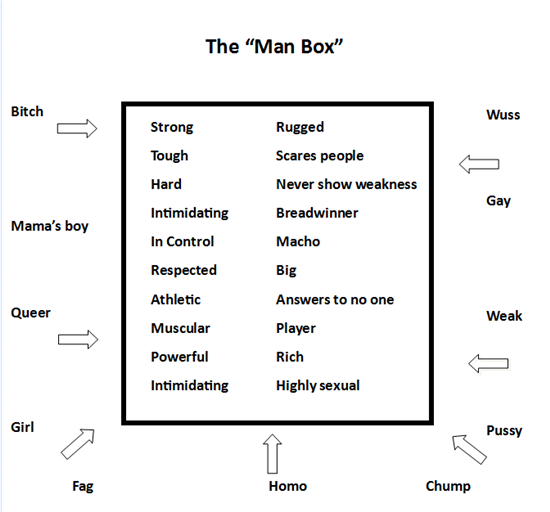
First of all, we have this misconception that to be a man a person must follow certain characteristics. Kids learns this at an early age through their father’s way of doing things and applies it to their daily life. One of the misconception is that violence is often the single most evident markers of manhood (Kimmel 148). Without any context of Jaden and the bully’s relationship, we can assume that they had a conflict and the only way to solve it is through violence. Our society has normalized this idea of solving a problem through violence because talking it out and expressing their emotions is considered to be feminine and would destroy their manly image in school (Kimmel 2). This case is not uncommon, the CBC stated that 41% of boys have been physically assaulted. This shows that the stereotypical concept of man is still very present in our generation. Although violence has no place in our world, boys have no other choice but to apply violence in school to assert their dominance and prove their manliness because they believe that it is a necessary process to become a man.

Secondly, boys are not the only victim in school, girls often receive worst assaults. This is due to the fact that boys believe that they are superior to girls and as a result they view them as a toy and play and touch them whenever they want without consent. In addition, because to be a man is to not be a woman and being strong is attributed to man, boys believe that girls are weak therefore they think that doing stuff to them wouldnt have any consequence. Men gain status and achievement in many things they do such as sports, work and notably sexual conquest (Kilmartin 3). However, if they fail to seduce a girl they will bring another stereotypical trait a man has to achieve their sexual needs. Force and dominance is used to achieve it (Kilmartin 2). As proof, in the CBC video, a boy sexually assaulted a 9 year-old girl in the bus. This proves that the stereotypical concept of man not only harms men but also women.
Thirdly, I believe that these assaults are preventable to some extent. Schools should be able to control their students behaviour by fortifying their rules and adding cameras or employees to places such as buses in order to provide protection to students. The school’s main objective and concern is supposed to be their students however, in the CBC video it shows us that money and reputation is more important. As proof, letters were sent to multiple schools demanding for datas on school violence, schools demanded for high amount of money and others denied the request because it could potentially ruin their reputation. Not only is this morally wrong but it also motivates bullies to continue doing harm to others because they recognize the school’s inability to act and respond to violence.
In conclusion, the way we’ve been taught on how to become a man is poisoning the children into believing that violence and superiority is mandatory to be manly. Not only is it harming young boys but the girls are also affected by it because of certain traits a man has such as force and dominance. To prevent such thing from happening in the future generations, we must change the way we portray a man and encourage them to express their feelings without feeling feminine.
Work Cited
CBC News, CBC/Radio Canada, gem.cbc.ca/media/marketplace/season-47/episode-4/38e815a-011d8f47088
Kimmel, Michael. Masculinity as Homophobia. 1994.
Kimmel, Michael. “Masculinity.” International Encyclopedia of the Social Sciences. Ed. William A. Darity, Jr. 2nd ed. Vol. 5. Detroit: Macmillan Reference USA, 2008. 1-5. Gale Virtual Reference Library. Web. 9 June 2014. 1-5. Print.
Kilmartin, Christopher, and Andrew P. Smiler. “Defining Men’s Studies.” The Masculine Self, Cornwall On Hudson, NY, Sloan Publishing, 2019, pp. 1–7




 Lovers an Fighters | Section 21