Final Blog: Exploring Masculinity – Hockey Arena? Or a Battlefield?

A sport that allows fighting? Does that even exist? Until recently, I have come to know a very intriguing sport that have been played for so long now which actually let players fight in the rink! Bloodshed, pain and tears have been around Hockey’s history and part if its tradition. It is the only professional sports that allows such vulgar, yet very “manly” ways of handling matters. How does NHL professional and amateur players feels about this violent rule? What if they don’t want to fight? Do they have any choices? How do they handle such situation?

As I have searched through the web for more information about the violence in hockey, the “CODE” came by frequently. What was the CODE? Similar to the “manbox” in the 4th episode: Man Enough, they are abide to a long list of rules imposed to them as players. In order to be part of the team, they are required to be tough and ruthless. In addition to the manbox, added is the CODE. It is just like any hegemonic explanation of what is a man all about, the CODE is about solidarity, pride, and respect to fellow players. Like the manbox, men have standards and expectations to meet. A very good example is Dun, despite not wanting to fight, he had no choices, but to do so. Not only that he has to protect the name of his team according to the CODE, but he really needed to defend for himself to, if he did not want to be beaten up to death. He was well respected by his team, not for his dominance on the rink, but because of how gentle and affectionate he was, toward his team. This might be his “flaw”, being a man, is to be tough and to show no emotions in front of others, as it shows your vulnerability (Kimmel, p. 163). He was forced to put on a mask, so he will be accepted by surrounding, because what lies beyond the mask, are his attitude, feelings, and the true him, that he was forced to conceal to be accepted. Why are they so violent, though? As I have done my readings related to masculinity, Violence is the “manliest” way of showing dominance. According to the 4 themes of Brennon’s masculinity, Hockey players have the traits of all 4 categories. First of all, They are not allowed to “sissy”. In other words, anything is acceptable, just do not be a girl. Second, As they cannot show anything related to femininity, which is the base of the very definition of the singular masculinity, they show their emotions and dominance by being aggressive. Being a player in NHL gives such a prestige, as they are considered very successful to have gone so far in this professional sport. They are admired by so many and it is an activity where seeing professional women are hardly seen. Can I say that hockey is indeed a sexist sport? Until recently that is. Professional Women’s Hockey stepped up their game and have been supported by a lot of organisations, in 2019. Finally, they also have to be strong and independent, especially if the get in to fights. All 4 of this themes are very well related to how Brennon categorized masculinity.

We should stop supporting violence in hockey. Families and friends should be rejoicing of such an amazing career for the players, yet this hidden part of our national sports have not been heard.

How does the enforcers feel about this brutality that they consider sportsmanship? As we are not all raised in the same manner and of the same surrounding, our standards and attitude of what is tolerable violence differ as well. Some enforcers, according to The Fifth Estate – CBC – The Code, said that it is what made them joined hockey. It is what some players and even viewers find exciting and not the actual match itself. They very much like it and it should be something all hockey players know about. This implies that all players knew that this level of violence exists in the rink, yet they go for it. Some are actually fearing it, but they have no choice, because it is the sport, the career that fills them up. Knowing the brutality in game, they have decided to continue with it, because of their love for hockey. Some believes that this is a way to show dominance in the rink. To be feared and to be the number one, is to be the strongest in fights and not in game. To show you guys how much men crave prestige and power over those who are weaker than them. They would go that far for their own purposes. In parents point of view, it is agonizing to see their children getting beat up, yet they cannot do anything, because it is a set rule. Some veteran players have sons that are aspiring NHL players and they know what they will have to go through. Some said that they are worried, but they know what they are entering. As for the managers and the association, do they really care about their players? To a certain extent, yes they do, but they seem to care more about the amount of money earned. The majority of the viewers are actually supporting such violence on the rink and have come to support hockey for this sole reason. By abolishing the fights in the rink, they predict a huge loss in the income, therefore they only set up rules to protect the players from very vital damages; such as not allowing players to take off their helmets during fights. What is more worrisome about the violence in hockey is the fact that hockey is not hockey without the violence that comes along it.

β€œIt’s not hockey ya know, it’s figure skating on ice you know.”

A player

As some believes that hockey without violence is figure skating, a lot of the children took up from this and results violence even between young hockey players. A child’s mentality comes from what they see. As grown ups, professional hockey players should not set such a vulgar and brutal example for children. Especially those who are very well respected in the rink. The more recognition the man has, the more people would follow his lead. What would happen if the most honorable and respected hockey player on NHL be the type of person who beats up his nemesis to show his dominance? Guessed it right. Children who have seen such, would think that beating up other people would give him such honor. Thus, more and more people becomes violent. Parenting does not just come from the parents, everything that surrounds the child is what shapes him, his future, and his knowledge of what is right. Psychologically speaking, a child who’s exposed in a very violent household and addition to that, he is also a passionate hockey player, will surely be very aggressive toward his foes as he was continuously seeing violence not only in the rink, but also at home.

To conclude, the violence in hockey should not be supported for no matter what reason. Supporters of such scheme might find it very fun, as they are still youthful, but as they grow old and realize the impact of the violence to our future, which are the children, they might think twice of doing so. Researching about the violence in hockey gave me an opportunity to see the other side of it. When I arrived in Canada, never have I ever thought that this is an actual thing, until recently. I hope that I have elaborated my ideas right to convince you, the readers, that violence is not always the key to solve problems. Maybe speaking your mind off would solve it.

Exploring Masculinity: School Violence

The act of violence in school is still present and prominent in this day and age. Many students have had to deal with everything from bullying to fighting. To the extent that CBC has aired an episode on this matter, it mainly talked about the reasons behind the violence. More specifically the reason why boys act more violent, how the school plays a role in the issue and how the false meaning of being a man has impacted these young men.  

First of all, it is said that young men are more likely to be in a fight at school or get bullied because of the way that many of them have been brought up as kids. From an early age, boys are taught to be aggressive and rough to show that they are not afraid and that they are the alpha male. For this reason, many boys bully others and get bullied in school. In fact, in a survey conducted by academics, results have shown that 41% of boys have been physically assaulted. This percentage is largely due to how many have misconceptions about the meaning behind a real man. In Kimmel masculinity it states that in Surveys in Western countries indicate that men construct their ideas of what it means to be men in constant reference to definitions of femininity”. This means that men believe that to be a real man is to be the opposite of a female. For example, how the norm for a female is that they are gentle, sweet and caring, thus men should be the exact opposite.  This is exactly the cause for violence in young men, they act in a certain way to be perceived as someone more manly. 

Secondly, the reason that violence in school won’t cease to increase is because of how the school and its staff handle the situation. It is a fact, when I say that some schools flat out ignore their violence issues and decides to blame the students for this type of behavior. Instead of fixing the problem and dealing with it. A perfect example would be how the school staff in Newfoundland kept trying to avoid the question by not answering it. This shows that the school is quite aware of its issues but doesn’t want to face it because they care more for the image of the school than their own students. To further prove my point, when the interviewer contacted certain schools on their school violence, there was one schoolboard that replied by saying that it will create reputational risk for the school. To again show that the institution plays a big hand in the issue and that by prioritizing the school it will negatively impact the students. 

Finally, it is also the fault of the other students for not trying to improve the situation. Mainly the ones that decide to stay quiet and not come forth on the truth. In this aspect, men are less likely to tell on one of their friends and even on someone that they don’t necessarily consider a friend. The reason being the bro code, where a guy put another guy above everything for the sake of this code. For example, most guys would not come up and snitch on another guys even if he knows that what he is doing is wrong. Furthermore, many guys do not like violence, but they must show that they do, in order to fit in and be perceived as a man by the others. Therefore, β€œViolence is often the single most evident marker of manhood” (148).  This shows that many acts in a violent way because of how it is closely related to the word man. 

In conclusion, violence in school is due to the misconception of the idea of a β€œman”, the negligence of the school and the students. To finish, the issue of violence in school should be a bigger priority for many and have better measure in place to reduce the percentage of violent acts in school. 

Work citedΒ 

Kimmel M. Masculinity 

CBC School violence: How to fight for safer school 

https://gem.cbc.ca/media/marketplace/season-47/episode-4/38e815a-011d8f47088

Exploring Masculinity: School Violence

Violence is very present in each school. Each teenager faces at least once in his high school years. The Canadian Broadcast Corporation episode: β€œHow to Fight for Safer Schools” shows that many kids in school’s face bullying and dangerous fights at school. This episode displays that girls and boys get assaulted in school. Girls tend to get more sexually assaulted and boys tend to get more being bullied: β€œ41 percent of boys say they were physically assaulted at high school; 26 percent of girls say they experienced unwanted sexual contact at school, and one in four students first experienced sexual harassment or assault before grade 7”.

First of all, young teens, specifically male are filled with the wrong information on how to handle a situation. For each argument they have, they respond it with fights each time because they think this is how you handle a situation in a β€œmanly way”. They respond to it with anger and everybody thinks it’s normal because this is how a man is supposed to be; how a man is supposed to react. A man has to be strong, deal anger with anger. Men are taught at a very young age what is to be a man. Whether it’s their dad or another male teacher at school. The society pressures young men to follow masculinity so much that in a way they corrupt young men at an early age. Some disrespect and hate women so much that they even rape them. These types of men can consider β€œAntifeminist”, where they just don’t care about any women and, they can do whatever they want. Also, some men can’t see a woman being superior to them. For example, at work, where a boss is a woman and for their ego satisfaction they tend to sexually assault them or bring them down (Kilmartin, Working). As seen in the episode, a young girl was raped by a guy from her school. Two other girls came forward after she reported to her school. The rapist still got away with it and came back to school. The school board did nothing to protect these girls. They seem to care more about how they would look rather than being worried about having rapists in their school. 

Second, off all, boys tend to fight because of bullying. If they tell a supervisor, they are labelled as a snitch and weak, meaning they can’t fight or handle a situation β€œman to man” and that’s where their masculinity is tested. The reason why fights are happening a lot in Newfoundland is that schools are not taking these issues seriously. In the Canadian Broadcast Corporation episode, we witness that the interviewer tries to interrogate a staff member at a school, but she refuses to answer his questions. It shows that her school is not handling the bullying and fighting problem correctly and that’s why fights keep on happening over and over in that school and every other school that’s not handling it properly.

Lastly, young men tend to react in violence because they think it’s dope to be in fights. They think maybe this will make me popular in school and my crush will notice me. As seen in many teenager’s movies, we always show that the most popular guy is dating the most popular girl. She is most likely to be a cheerleader. This may be a stereotype, but it is very accurate as well. Although our life isn’t a movie, young men follow this perception but the ending rarely end up like in movies. To hide their feelings, men lash out the anger that ends up in a fight against someone else and this is taught not only by fathers but also by people from school. It may be a basketball coach that tells you: stop crying…Crying is a feminine behavior and you’re not a woman as we saw in the β€œMan Enough” documentary. I think that is why there is so much violence at school

To conclude, schools are allowing it because they are not handling the situation as they are supposed to. As seen in the episode, the schools were even asking money for them to be interrogated and, they were also scared about their reputation. They know that they aren’t doing enough about bullying in their schools.

Work Cited

Christopher Kilmartin and Andrew P. Smiler β€œMen at Work: Jobs, Careers and Masculinity.” The Masculine Self, Cornwall On Hudson, NY, Sloan Publishing, 2019, pp. 221-226,228–235.

Kilmartin, Christopher, and Andrew P. Smiler. β€œDefining Men’s Studies.” The Masculine Self, Cornwall On Hudson, NY, Sloan Publishing, 2019, pp. 1–7

Newsom, Jennifer S, Jessica Congdon, Jessica Anthony, Regina K. Scully, Joe Ehrmann, Michael S. Kimmel, Caroline Heldman, Lise Eliot, Michael G. Thompson, William S. Pollack, Carol Gilligan, Madeline Levine, Judy Y. Chu, Terry A. Kupers, Niobe Way, Pedro Noguera, Philip G. Zimbardo, Byron Hurt, James Gilligan, John Behrens, and Eric Holland. The Mask You Live in., 2015.

CBCnews, CBC/Radio Canada, gem.cbc.ca/media/marketplace/season-47/episode-4/38e815a-011d8f47088.

Mcguire, Jennifer. β€œWhy CBC Started Looking into Violence in Schools.” 8 Nov. 2019, https://www.cbc.ca/news/canada/school-violence-editors-note-1.5331402.

Mcguire. β€œMost Schools Keep Violent Incidents Secret, so We Surveyed 4,000 Students. Here’s What They Shared | CBC News.” CBCnews, CBC/Radio Canada, 9 Nov. 2019, www.cbc.ca/news/canada/school-violence-marketplace-1.5224865.

Exploring Masculinity: Fighting, Concussions and Suicide in Hockey

In the culture of the NHL fighting is part of the game, the physicality, non-stop action, the nature of it is just expected from the game as per the NHL commissioner, Gary Bettman. For the players who were chosen to be the instigator they were chosen not for their great hockey skills but rather for their tough masculinity, their sheer physical strength and that ruthless male attitude which would make any other player shiver next to them. It was expected that they would put on that rough physique to good use on the ice and perform to the league’s expectations. The dangers and consequences were second though, at that time. They were expected to take care of the star player on the ice putting their physical force in front of the opponent’s teams other enforcer.

The effects of the concussions on the payers were numerous; sleeplessness, agitation and confusion. These players were referred to as, goons, policemen, enforcers. There were defined by their protective capabilities towards their teammates on the ice which was to keep them safe and to make sure nothing happens to them. Much as society has defined men’s roles as the provider, the fighter and the protector of the family, so were these pro hockey players to their teammates. The inner battle felt by these players to fight during the game as was expected of them took a toll on their lives.

These athletes love for hockey was plagued with the instilled culture of violence and fighting that was expected of them because they were the ones who were rounded up to be the enforcers, and had to follow the β€œcode” of the NHL culture. Players felt that they have no choice but to fight. Although they did not want to, it was an unspoken understanding that to remain in the league they had to. They were expected to follow the β€œcode” as it is commonly known in the organization, an unwritten law of hockey whereby the tough man on the team gets to protect their teammates and some of them have paid for it with their lives. These enforcers would like to be able to just play the sport with their skills and tactical talents, they do not want to fight they do not like to fight they do not appreciate being targeted at the goon of the team.

This shows how society chooses to designate some players physically strong, to act out a masculine tough tenacious role. If we think about how social scientist, Robert Brannon explained the four themes of masculinity onthe Brannon’s Masculinity Scale, we can relate them to the β€œcode”. In the Fifth Estate docudrama β€œThe Code”, staying true to the β€œcode” forced many players to fight, because if you weren’t willing to combat you were seen as a sissy, the shame and dishonor you would bring to your teammates was unthinkable and therefore you could be typecast as having feminine tra its and qualities if you showed any sign of weakness which was unacceptable. What was accepted in the β€œcode” as per Brannon’s definitions of masculinity, was having a manly, firm, courageous, tough, self-determined demeanor.

Players would follow the β€œcode” religiously and because of it gained success and stardom on their team in the eyes of the fans. This inevitably fed into their ego and they continued to live by the rules of the β€œcode” since it allowed them to gain recognition and success status even if they didn’t like the altercations, which is another way that Brannon explained the masculinity theme through his eyes. Another one of his views, can be illustrated by how he saw masculinity and how we can relate it to the β€œcode” which is simply by the sheer violent, aggressive, bold attitude and presence that was expected from the athletes who needed to abide by the unwritten rules of the game in order to maintain their position as enforcers on their team.

Masculinity refers to the social roles, behaviors, and meanings prescribed for men in any given society at any one time (Kimmel). The role society plays and has always played in defining a man and his masculinity carry over into the philosophy of this sport whereby the toughness and roughness of the players forms an integral and expected part of the game. Even if the players do not agree with or do not want to fight it is expected of them in this sport, much like when in society the powerful and culturally expected connotations of being a real man come into play (Kilmartin).The fighting was shown to be an integral part of hockey it was not only about your physical and strategic strength that mattered here but rather that forceful tough guy manhood that had become established on the ice. Enforcers, as they were commonly called, had to put up with the brawl in order to maintain their career, anything less than that aggressive masculinity would have them thrown out of the hockey league.

They knew that they had to fight to maintain their position. Even as the NHL was being plagued with sudden deaths of its players, known as the enforcers, the league did nothing about it preferring instead to maintain this culture within the ir teams. The enforcer’s tasks on the ice were quite clear, fight on the ice. It is no doubt that this led these players to have multiple concussions. In the Fifth Estate documentary, β€œHockey Fight: Wives reveal the cost of concussions”, some of the wives of these pro athletes are pushing for more support for the after hockey life for former athletes especially since their husbands committed suicide due to their sustained head injuries which were proven to cause debilitation brain effects, known as CTE, Chronic traumatic encephalopathy, which is a neurodegenerative disease caused by recurrent head injuries.Β  The symptoms generally appear many years after the injuries have already taken place and cause issues with thinking, mood changes and attitude problems, no doubt due to the fighting on ice fuelled by the rough, macho masculine culture established within this sport.

We expect men to be tough and this is seen clearly in this sport, not fighting is unacceptable as shows weakness and men are not meant to be seen as weak. This type of behavior is expected it is part of this game and mind culture as spectators roar at the sight and sounds of the battle being played out between two tough guys on the ice. For a moment we forget we are actually watching a sport as it feels much more like watching sheer violence unfolding in an arena pa cked with thousands of people. One of the ways masculinity is seen is when a man is willing to become tough, violent and be willing to engage in physical force (Kilmartin). Showing emotions or vulnerability in a vigorous man sport like hockey could get you thrown off the team. This attitude is enforced and awarded when the chosen players are labeled as enforcers bringing with it fame and success. In the documentary, β€œPain, agony and ‘years of duress’: How hockey wives are fighting back over players’ chronic brain injuries” it is mentioned that it’s the 3rd suicide of enforcer designated players, leading loved ones to believe a link between the sustained head injuries and their suicides. The wives of hockey players are going up against the NHL to enforce them that there is indeed a connection between their husbands head traumas, the effects of those on their health and families, as well as debilitating behaviors that have developed following these traumas. Β 

They feel very much left on their own to protect their husbands, former tough guy hockey pro players who followed the unwritten rules of the β€œcode” and fed into the hooligan thug like masculine presence that was expected of them on the ice. Some of these players have since committed suicide unable to cope with the aftermath health affects their brains and bodies endured during their time on the ice. The organizers of the sport and even well-known hockey commentators, such as Don Cherry, as seen in the Fifth Estate documentary β€œThe Code”, explain that fighting is good for the sport and for tough guys, and enforcing the dominance of violence in this sport is acceptable and just part of the game as it has always been thus feeding into the dominance meaning of masculinity as seen within the hockey culture. Masculinity as explained by Kilmartin, and as shown in this documentary explain how men are constantly fed and encouraged to behave and engage in violent battlesΒ  as it is portrayed as manly and masculine.

As the documentary explains, the role of the enforcer is being phased out, which no doubt will relieve the players that were designated to play those roles. It is essential that this sport acknowledge the damage it has and still in ways instills upon its players, because the approach of the game using their players as bullies, and goons for so many years has fed their fans in delight glorifying violent masculine behavior. Young children watching the sport could be influenced seeing this as normal accepted behavior for men, carrying it forward with them into adulthood. It is unfortunate thought that the league goes into a defensive mode anytime the subject of this enforced fighting is brought up and in consequence not recognizing the brain injuries, such as substance abuse, depression, memory loss and suicide that many of the players have had to deal with.

                                                              Works Cited

Brannon, Robert, and Samuel, Juni. β€œA scale for measuring attitudes about masculinity”

https://nyuscholars.nys.edu/en/publications/a-scale-for-measuring-attitudes-about-masculinity

Kilmartin, Christopher, and Andrew P. Smiler. β€œDefining Men’s Studies.” The Masculine Self,

Sloan Publishing, 2019, pp. 1–7.

McKeown, Bob.  β€œHockey Fight: Wives reveal the cost of concussions”      

https://www.cbc.ca/fifth/episode/2019-2020/hockey-fight-wives-reveal-the-cost-of-          concussions

McKeown, Bob. β€œThe Code”, www.cbc.ca/fifth/episodes/2009-2010/the-code

Smart,Virginia, and Ellenwood, Lisa.  β€œPain, agony and ‘years of duress’: How hockey wives are

fighting back over players’ chronic brain injuries” https://www.cbc.ca/news/canada/hockey-players-enforcers-brain-injuries-1.5370444

Final Project: Exploring Masculinity

Nowadays, our society is surrounded by fights, violence, and intimidation. It is current to see more boys having those types of behaviours than girls. Men act in such a way, even though they are not good with it, because of their surroundings and the way society raised them. In this blog, the way society thinks, supports, and teaches men that success is important will be tackled, explaining where those kinds of behaviours are from and their effects on their lives.

First, society really does banalize fights. We think that because they are boys it is fine if they fight. We see fights as being a part of what a boy is supposed to be. β€œMasculinity is characterized by a willingness to take (physical) risks and become violent if necessary”1 Therefore, society goes with the mentality of β€œboys will be boys” and that fighting with each other is part of their development. School even goes till hiding how many fights happened in their institutions because for them, it is not an important enough problem, and they don’t want to deal with it. Even more, if boys refuse to fight, people won’t see them as real men, but rather as wimps who are scared to fight. Also, in other platforms such as hockey, people don’t consider hockey as a real sport if there is no fighting. Fights certainly do bring a feeling of manhood2 to the one who watches but also to the one who plays. Taking away fights will probably create a decrease in the number of people who watch it, thus, the incomes will decrease as well. Since people live for money, fights won’t be taken away from the NHL. In brief, since we expect boys to fight, we teach them that it is allowed, and it continues to be inhaled in our lifestyle and as they get older, they like being entertained by it too.

To continue, men don’t have access to a lot of moral support. Throughout their lives, men have been raised by learning that they shouldn’t express their emotions as well as their problems. β€œFurther, they should solve problems without help, keep their feeling to themselves, and disdain any display of weakness.”3  Therefore, when men aren’t feeling cheerful in what they are doing, which is the case of the players who are hired to fight in the NHL, they don’t think they are allowed to talk about it and to ask for help before it gets too late. More, since the NHL assumes that their players are all real men, they assume that they don’t need to talk about how they feel, offering no support to their players. Therefore, the lack of support present in the NHL can explain why players reach a point where they think about committing suicide or even do it. However, as the NHL doesn’t want to deal with men’s problems, the players’ wife is the only one really present to help and support them. With the gender role we grew in because of institutions, women are seen as the supportive one and the one who should take care of the other.4 Thus, we assume that it is the woman responsibly to take care of how their man feel and to support him. Overall since men don’t have any resources and haven’t learned to talk about how they feel, it can lead to very big consequences.

Moreover, men have been taught since a young age that if they want to be a real man, they have to succeed in life. The achievements and the success they reach are pretty important for men, and they can be described by the amount of money they possess, the number of girls they are surrounded by, and by their job. Almost every little boy once dreams to play in the NHL, thus success for men can be described as reaching this level. Also, once they reached the NHL level, they have fans, money, girls, in other words, they have success. Therefore, they reach what little boys dream of, and at the same time, what men dream of. However, some of these players are only enrolled to give a show by fighting, and they are not truly happy with this. But if they want to keep their success they have to stay in the NHL. Consequently, they have to fight, otherwise, they will be kicked out of the NHL and subsequently lose everybody’s admiration. Due to the importance we accord to their status and achievement, players rather reach success by fighting than being mentally healthy. To sum up, fights in the NHL continue because no one opposed to them, not even the players because they want to keep their success.

To conclude, by imploring standards for men to follow, we put them in a position they don’t really want to be in, for example, fights. Society’s standards do affect the number of fights and violence we are surrounded by. To give a term to these acts of violence, we, the whole society, will have to stand up against it.


Kilmartin, Christopher, and Andrew P. Smiler. β€œDefining Men’s Studies.” The Masculine Self, Cornwall On Hudson, NY, Sloan Publishing, 2019, pp. 6.

Kimmel, Michael S. “Sexuality and Intimitate relationships.” Masculinity as Homophobia. 1994. 147.

Kilmartin, Christopher, and Andrew P. Smiler. β€œDefining Men’s Studies.” The Masculine Self, Cornwall On Hudson, NY, Sloan Publishing, 2019, pp. 7.

Kimmel, Michael.β€œMasculinity.” International Encyclopedia of the Social Sciences. Ed. William A. Darity, Jr. 2nd ed. Vol. 5. Detroit: Macmillan Reference USA, 2008. 1-5. Gale Virtual Reference Library. Web. 9 June 2014. pp.1-5.

Kilmartin, Christopher, and Andrew P. Smiler. β€œDefining Men’s Studies.” The Masculine Self, Cornwall On Hudson, NY, Sloan Publishing, 2019, pp. 7

Christopher Kilmartin and Andrew P. Smiler β€œMen at Work: Jobs, Careers and Masculinity.” The Masculine Self, Cornwall On Hudson, NY, Sloan Publishing, 2019, pp.221-235

Exploring Masculinity: Fighting, Concussions and Suicide in Hockey

On December 12th, 2008, Don Sanderson, a 21-year-old hockey player, was put into a coma and died after three weeks after he was in a fight at one of his games. His goal, from what he told his father, was that he did not want to fight, however, fighting is a part of the hockey culture. It’s a sport where the athletes get to show how strong, dominant and aggressive they are on the ice, pretty much how much of a “man” they are. Hockey is a violent sport; however, most hardcore fans will say that there is a “code” that everyone knows that makes the game safer. That code still falls under those stereotypical traits of masculinity.

First off, hockey is the only sport where fighting is allowed, and a lot of players, like Don Sanderson, did not want to fight. However, players are forced to fight to help out their teammates, such as George Laraque, the “enforcer” of his teams (Edmonton, Phoenix, Pittsburgh and Montreal). Laraque explains that his role in the team was to make sure that his teammates were safe. According to Kilmartin’s text “No Man is an Island: Men in Relationships”, instead of complimenting each other and saying meaningful stuff, men will often show friendship by helping each other out (Kilmartin: No Man is an Island: Men in Relationships). Moreover, CBC tells the viewers, in their episode “The Code”, that protecting your teammates is “the essence of hockey’s unwritten law”, and in the case of Don Sanderson, the only reason why Don would fight was to help his teammates. After his first games, Don called his dad and told him that he got into a fight, and when he was asked why, Don said that he was helping out his captain and that his captain was more important to the team. Some of these “kinship” rules can also be seen in places like the schoolyard, where some boys would be excluded from a group for not helping their friends, or not fighting alongside the group. In sum, most of the time, when players who don’t want to fight to end up fighting, is to protect their friends and teammates, which is how men make “real men” make friends.

For Don Cherry, the code is to fight with honour, which can relate to Brannon’s four themes of masculinity. The first one, “Antifemininity”, refers to men avoiding feminine traits (Kilmartin: Defining Men’s Studies). Furthermore, what I learned in Anthropology when A roman gladiator fought with no fear of death, the crowd would consider that honour. Therefore, in this hockey context, I would assume that fighting with no fear would be considered “fighting with honour”. The second one, “Status and Achievement”, is pretty self-explanatory, the man has to be successful in whatever he is doing, which would mostly be sports, work, and/or sexual “conquest” (Kilmartin: Defining Men’s Studies) In hockey, those who are more successful are those who win more fights. Furthermore, a lot of hockey players are in the NHL for their fighting ability rather than their hockey skills. The third element, “Inexpressiveness and Independence”, describes a man to be strong no matter what and should not depend on others in any situation (Kilmartin: Defining Men’s Studies). Strength can be measured in many forms such as physical (muscles or stamina) or mental (Strength od character, dedication, or stubbornness), and in hockey, it would mostly be the players that have the most strength, physically and mentally, who are the most recognized in a team. Lastly, the fourth element, “Adventurousness, and Aggressiveness”, explains that men should be willing to take physical risks and have the ability to be aggressive when they have to be (Kilmartin: Defining Men’s Studies). Taking physical risks and being aggressive is something you need in all sport, you always have to push the distance of your physical ability to achieve greatness and, during games, you need to be aggressive so that you can use the full extent of your body and muscles. In sum, Don Cherry’s definition of The Code can fit the terms of Robert Brannon’s “manbox”,

Finally, some players are not in the NHL because of their skills on the ice, but rather their fighting abilities. As most fans and players will tell others, fighting is a big part of hockey, and according to Jon Mirasty, hockey without fighting is just figure-skating. In Kimmel’s text “Masculinity as Homophobia” it states that violence is a big marker of manhood (Kimmel: Masculinity as Homophobia), which would usually lead to people thinking that the person has an aggressive and daring personality. This is a tactic that some teams use in the league, instead of scaring the other team by having good plays and winning all the time, they make sure that the players are big and strong and can hit very hard. According to Nick Kypreos, hockey is based on intimidation, which comes back to Kimmel’s text saying that manhood is associated with power (Kimmel: Masculinity as Homophobia). In the hockey context, using intimidation to make the other team fear them lets them have power over the other team and allows them to control the game even more. The intimidation tactic can and will also be let the fans and the other team know who the dominant team is. In sum, certain aspects of manhood is also used as a tactic to make the game a little easier from one of the two teams on the ice.

In conclusion, even if hockey those have a lot of fights, you can’t just yank it out of the sport, since it might lead to more malicious tackles between players. I am not saying that The Code is making the game safer, and I am not saying that it is not, because I don’t enjoy watching fighting in sport. Of course, taking out fights may cause you to lose fans and money, since Don Cherry pointed out, 70% of the people associated with hockey enjoy the fights. One way I could think of to solve the issue at hand is to teach the young kids to not do that since athletes mostly remember the aspects they learned when they were young. However, to have that big of an impact, you will need to have a whole new generation of hockey players, and there is also the problem of the NHL losing money. Therefore, taking fighting out of hockey is a hard decision to make.

Reference:

Exploring Masculinity: Fighting, Concussions and Suicide in Hockey

INTRO

Hockey is a sport for the cultural man, because it’s a stage for men to show off their dominance, strength, aggressiveness and competitiveness so they can show everyone who the strongest is.

The cultural man is defined as strong, dominant, tough, aggressive, physical, competitive and forceful which are all adjectives that that describes what hockey fans think you need as a hockey player. Things that you need to be able to do as a man: takes action, protects women and children, gets the job done, takes risks (Kilmartin, Defining Men’s studies). Also, physical risk-taking is one of the negative aspects of today’s masculinity (Kilmartin, Men at Work: Jobs, Careers, and Masculinity). Nick Kypreos said in β€œThe Code”, the hockey documentary that, he himself dropped his gloves and fought just to show that he still a tough guy and physical force. Also, they say in the documentary that teams use this method in order intimidate other teams and win games.

Toughest Hockey Players in NHL History | Stadium Talk

β€œThere is a deep tension between intimacy and masculinity. He wants both, and each seems to be purchased at the price of the other”’ (Kilmartin, No man is an Island: Men in relationships). This causes them to not be open about certain things in their life, such as the negative suicidal thoughts that hockey players feel due to the fighting and concussions on the ice like the hockey player Todd Ewen or Wade Belak. This is why men should feel more open about their feelings and share it with others so their close ones can help. Moreover, β€œ[…] he may find it very difficult to β€œflip the switch” that turns on all of  the emotional and relationship attitudes that he has suppressed all day at work” (Kilmartin, Masculinity). In other words, at work, which in this case is ice hockey, they contain all their emotions and act like another person so, when arrived at home, they find it not only physically challenging to spend some quality time with their family, but also mentally challenging because they know they spent the whole day being aggressive on the ice with other players. This was something that some players wholeheartedly hated doing just like Todd Ewen who told his wife that.

Why Am I Always Tired ? - CPAP sleep study test, equipment, supplies

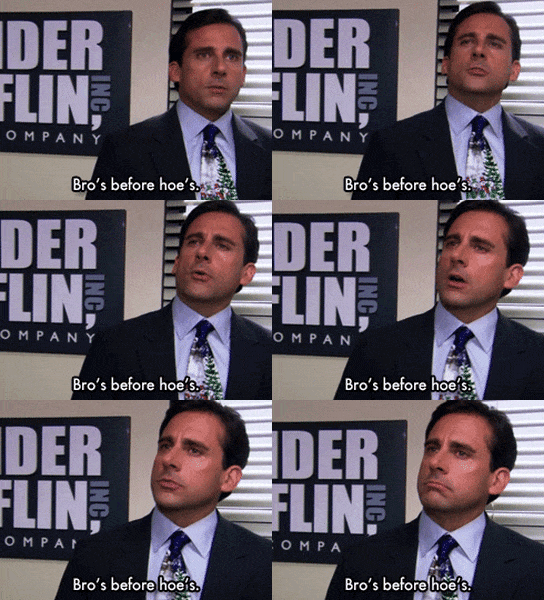
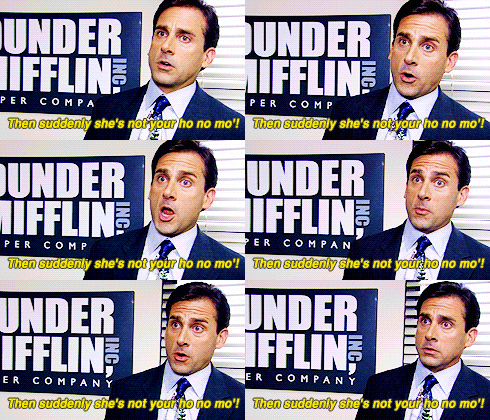
The code in hockey is similar to the bro code that young adult boys respect nowadays. It’s a β€œprinciple” that basically states that you put your boy friends before girls as a guy or a man. In hockey, it states things like don’t body check with your stick or to take off your helmet when fighting another hockey player to protect his hands. β€œWhat it means to be a man varies in different institutional contexts, and those different institutional contexts demand and produce different forms of masculinity”.  This means that just like the bro code, the hockey code is also an institution that forces some of these men to participate and practice this code, meaning that they feel obliged to fight because everyone else is doing it and telling them to do so. β€œBoys may be boys, […] but they express that identity differently in fraternity parties than in job interviews with a female manager” (Kilmartin, Masculinity). This also means that similar to movies, they show how the man respects the bro code when they are with their girlfriend and they just leave her even if they didn’t want to because his β€œboys” are here even though he would prefer to stay with her. It’s almost as they flip a switch that transforms how they act. I for one have seen this happen with one of my friends whenever we arrived as a group and saw him with his girlfriend at school for example. Not often of course, because we’re the type of friends that leave couples in the friend group some space.

The Office Television GIF - Find & Share on GIPHY
Bros before hoes television the office GIF on GIFER - by Nilathris
The Office Ho GIF - Find & Share on GIPHY

CONCLUSION

All things considered, these hockey players are no different from other β€œaverage” men who suffer from emotional suppression, respecting the cultural man norms, and feeling like they have no one to go and develop some suicidal thoughts. This means that despite the fact that these hockey players are around other people such as their teammates and coach, they can still feel lonely, unlike office workers, for example, who spend the big majority of their time only working with numbers on paperwork in front of a computer and not actually talking to anyone. Β 

Works Cited

Kilmartin, Christopher. “Defining Men’s studies.” (n.d.): 1-7.

β€”. “Masculinity.” (n.d.): 1-5.

β€”. “Men at Work: Jobs, Careers, and Masculinity.” (n.d.): 221-235.

β€”. “No man is an Island: Men in relationships.” (n.d.): 161-171.

Exploring Masculinity: Violence in schools

Violence in schools is one of the hardest things teenagers face in school. As shown in the Canadian Broadcasting Corporation episode “School violence: how to fight for safer schools”, an interviewer reports issues of gender-based violence that schools in Canada are facing. In the video we are shown the difference of what dangers boys and girls face in schools. For instance, boys face more cases of bullying and physical assault and girls face more cases of sexual harassment/assault. Research shows that “41 per cent of boys say they were physically assaulted at high school; 26 per cent of girls say they experienced unwanted sexual contact at school; and one in four students first experienced sexual harassment or assault before Grade 7.” (McGuire)

Young men have been filled with so much destructive information about women. Young men have grown into this negative way of thinking because of what society puts out in there about women and men. “What it means to be a man is to be unlike a woman… the β€œantifemininity” component of masculinity is perhaps the single dominant and universal characteristic.” (Kimmel 2) Men try so hard to be nothing like women because they feel a women is someone with no value and should not be valued by society. That is why as soon as they feel as though a women is a threat to them they feel they need to take away that power and strength they have inside them by raping them and making them feel low of themselves. Not all men are like this but the men who try so hard to push away femininity and bring women down by sexually assaulting them is because they hate the thought of women having more power over them, therefore, they try to dominate them. In the video of the Canadian Broadcasting Corporation we see women protesting to stop sexual assault in and outside of schools. This shows the strength and courage women have and no matter how hard men try to bring them down, they rise back up. Thus, that is why men become so angry because they feel threatened by women. Same goes for boys in school who sexually assault girls, they try to lower their confidence to higher their self esteem by empowering them and this begins to show from young ages. In the end, young girls need to come together in schools if they want to stop this violence and show boys that whatever they do it is never going to bring them down.

Boys who experience physical assault in schools is normally from bullying. “The fear of being seen as a sissy dominates the cultural definition of manhood”. (Kimmel 147) This proves that the reason most boys are violent is because they are afraid to appear like they are weak to other boys. Therefore, they try so hard to put out an imagine like they are tough and they are stronger than anyone else. These scenarios usually occur in schools, especially high schools and that is why there is so much violence in schools. “Violence if often the single most evident marker of manhood”. (Kimmel 148) Unfortunately, we live in a society that the only way for a boy in school to get that reputation of being ‘cool’, is by being violent and if you are not, you end up getting bullied and usually experience physical assault from other boys. Hence, this is why “41 per cent of boys say they were physically assaulted at high school” (McGuire).

The reason that violence in schools has not been dealt with properly is because teachers and staff have not been taking this issue serious. In the Canadian Broadcast Production we see the interviewer trying to get answers from a staff member at a high school in Newfoundland. As he tries to get answers from the staff member, we see that she doesn’t want to answer his questions or talk about the issue at all and tries to wrap up the conversation and leave. This gives out a clear picture that schools are not putting an importance on this issue and don’t want to try and make their school a safe living environment for their students. In the video the schools sent out letters stating they didn’t want to talk about the violence that has been happening because they don’t want their school to have a bad reputation. Therefore, this is why violence in school has not ended because staff members feel as though protecting their reputation is more important than protecting children facing this violence.

To conclude, gender-based violence in schools is such a big issue high school students face and an issue that needs to be made important so that students can go to school feeling safer. This issue should be brought upon parents of young boys, since it is boys who are the centre of physical and sexual assault. I feel as though parents should stop raising their sons to become strong and tough men and raise them to be respectful and caring men. This stereotype that girls are objects and men are more inferior to women, needs to be shown as completely disgusting to boys when they are young so that they know that we are all equal and we were born to love each other. By doing so, violence outside and inside schools will end and all this hate brought upon men to men and men to women will officially come to an end.

Works Cited

Kimmel, M. Masculinity. 1987

Kimmel, M. Masculinity as Homophobia. 1994

McGuire, Jennifer. β€œWhy CBC Started Looking into Violence in Schools | CBC News.” CBCnews, CBC/Radio Canada, 8 Nov. 2019,Β http://www.cbc.ca/news/canada/school-violence-Β editors-note-1.5331402

Common, David, et al. β€œβ€˜I Thought He Was Dead’: CBC Survey Reveals 4 in 10 Boys Are Physically Assaulted at School | CBC News.” CBCnews, CBC/Radio Canada, 8 Nov. 2019,Β http://www.cbc.ca/news/canada/school-violence-marketplace-1.5224865.

Exploring Masculinity Through Violence in Schools

The Canadian Broadcasting Corporation’s staggering series on the issue of violence in Canadian schools calls attention to an independent research conducted which reveals that Canadian students experience gender-based violence from a very young age. The research divulges that girls tend to experience gender-based violence mainly through sexual harassment and/or assault while boys tend to experience gender-based violence primarily through bullying. Toxic societal perceptions and definitions of masculinity appear to facilitate and even encourage gender-based violence in schools.

Toxic societal perceptions of masculinity gravely affect the portrayal and treatment of women and young girls in society. Fears of being regarded as effeminate are instilled in boys at a young age and discourage them from adopting any stereotypically feminine behaviours. These fears even go so far as to encourage young boys to both view and β€œvalue girls and women only as sexual objects,” making the development of healthy male-female friendships extremely difficult for many (β€œMen in Relationships” 171). In addition to preventing boys from creating deep, meaningful friendships with girls, fears of being perceived as effeminate drive boys to act overtly β€˜manly’ or β€˜masculine,’ and pushes them to exaggerate β€œall the traditional rules of masculinity, including sexual predation with women” (Masculinity as Homophobia 148). In fact, the Canadian Broadcasting Corporation’s research uncovers that girls often have a tendency to experience gender-based violence through sexual harassment and/or assault. A national online survey the Canadian Broadcasting Corporation commissioned revealed that β€œ26 per cent of girls say they experienced unwanted sexual contact at school” and β€œone in four students first experienced sexual harassment or assault before Grade 7” (McGuire). Toxic societal perceptions of masculinity allow and even seem to encourage gender-based violence against young girls. Boys and men who believe they are falling short of cultural standards of masculinity are motivated to overcompensate or exaggerate β€˜masculine’ attitudes and behaviours. Fears of being perceived as an effeminate male can make boys or men feel their masculinity is threatened by the presence of girls or women in school or in the workplace, ultimately causing women to become β€œthe targets of sexual harassment” as equality of the sexes can threaten masculinity and the sexual predation of women ensures that β€œthe playing field of male competition remains stacked against all newcomers to the game” (Masculinity as Homophobia 150). Fears of being emasculated or regarded as effeminate thus promote sexism and even sexual violence against
young girls.

In addition, the Canadian Broadcasting Corporation’s research imparts that young boys frequently experience gender-based violence through bullying. In Masculinity as Homophobia (1994), American sociologist Michael Kimmel shares that when he was young, one would ask a boy to look at his fingernails as a test of his masculinity. Kimmel explains that if a boy β€œheld his palm down toward his face and curled his fingers back to see them, he passed the test,” looking at his nails β€˜like a man’ would (Masculinity as Homophobia 148). However, if a boy β€œheld the back of his hand away from his face, and looked at his fingernails with arm outstretched,” he was instantly humiliated and ridiculed as a β€œsissy” by his peers (Masculinity as Homophobia 148).Growing up, young boys quickly learn that their β€œpeers are a kind of gender police, constantly threatening to unmask [them] as feminine, as sissies” (Masculinity as Homophobia 148). The national online survey the Canadian Broadcasting Corporation commissioned also revealed that β€œ41 per cent of boys say they were physically assaulted at high school” (McGuire). In fact, boys are even more likely to face violence than girls, β€œwith four in 10 boys between the ages of 14 and 21 reporting they were on the receiving end of an assault involving slaps, punches, kicks or bites” (Common). The fear of being regarded as effeminate plays a huge role in the constant bullying and humiliation of young boys who are pressured into not displaying any signs of β€˜feminine’ behaviour.

Moreover, young boys in schools are often scared to come forward about the violence they’ve either experienced or witnessed. The Canadian Broadcasting Corporation notes from the national online survey they conducted that approximately β€œ50 per cent of high school kids don’t report violence they’ve experienced or witnessed,” proving that violence in schools is a frequently unreported issue (McGuire). The team at Marketplace discovered that β€œkids don’t always tell authorities what is happening to them, perhaps because they fear nothing positive will come of it,” and for many young boys, reporting violence or bullying brings them no justice (McGuire). A student named Jayden interviewed by the Canadian Broadcasting Corporation shared with them that going to a teacher to report a violent incident usually gets one despised by their peers and labelled as a snitch. Young boys fear being segregated by their peers which they’re already pressured to be somewhat emotionally disconnected from with all those emotional display rules they are encouraged to follow. From an early age, young boys are encouraged to β€œavoid behaviors, interests, and personality traits” that are viewed as stereotypically feminine and pressured to not display any emotion as β€œemotion is often considered a central and defining characteristic of femininity” (β€œDefining Men’s Studies” 5). Another student actually confessed to the Canadian Broadcasting Corporation that when he tried to report that he was a victim of bullying, he was advised to β€˜toughen up.’ His masculinity seems to have been brought up to encourage him to disregard the issue he tried to report as well as push him to internalize the violence he was a victim of. Young boys fear being emasculated by other boys or men. They fear being seen as effeminate. These fears scare many young boys into keeping quiet about violence in schools.

By exposing the issue of gender-based violence in schools and by having open discussions about the issue, only then can we hope to eliminate the problem. We must first collectively recognize that there is a problem in order to then be able to understand some of the sources of gender-based violence such as the dire impact of toxic β€˜masculine’ ideals and societal definitions of masculinity which are forced down young boys’ throats. The β€œtroubling social trend” of peer-on-peer violence has a serious impact on students, the parents of students, and society overall (McGuire). Schools should be more concerned with the amount of gender-based violent incidents that occur in their school and the measures they’re taking to combat this issue, than the effect that releasing records on the violent incidents that have happened in their establishment may cause to their school’s reputation. Students harming other students, whether it be physically or emotionally, is a serious issue in schools that shouldn’t be overlooked or ignored.

Lastly, I would like to bring attention to “The Mask You Live In” which explores a narrow Western definition of masculinity and the harm it causes boys, especially through gender-based violence in schools, as well as explores the harm it causes men. Here’s a link to a brief trailer on β€œThe Mask You Live In” project: https://www.youtube.com/watch?time_continue=182&v=hc45-ptHMxo&feature=emb_title. I think this project is important as it urges us as a society to challenge prescribed gender roles and highlights how critical it is to have discussions about masculinity when boys are young, both at home and in classrooms, in order to decrease the likelihood or intensity of gender-based violence in schools.

Works Cited

Common, David, et al. β€œβ€˜I Thought He Was Dead’: CBC Survey Reveals 4 in 10 Boys Are Physically Assaulted at School | CBC News.” CBCnews, CBC/Radio Canada, 8 Nov. 2019, http://www.cbc.ca/news/canada/school-violence-marketplace-1.5224865.

Kilmartin, Christopher, and Andrew P. Smiler. β€œDefining Men’s Studies.” The Masculine Self, Cornwall On Hudson, NY, Sloan Publishing, 2019, pp. 1–7.

Kilmartin, Christopher, and Andrew P. Smiler. β€œNo Man Is an Island: Men in Relationships.” The Masculine Self, Cornwall On Hudson, NY, Sloan Publishing, 2019, pp. 161–171.

Kimmel, Michael. Masculinity as Homophobia. 1994.

McGuire, Jennifer. β€œWhy CBC Started Looking into Violence in Schools | CBC News.” CBCnews, CBC/Radio Canada, 8 Nov. 2019, http://www.cbc.ca/news/canada/school-violence- editors-note-1.5331402.

By: Alexandra Rose Morgan Arseneau

Blog 6: International Women’s Week

Last Tuesday, during International Women’s Week, a speaker, Jay Marquis-Manicom, came to talk to us about his thesis, “From the Red Pill to β€˜White Genocide'”. He talked about the Alt-Right and online male supremacism groups such as the Red Pill.

All of these groups support anti femininity. They basically want men to be superior than than women in every possible aspect. They all the praise the stereotypical white male, and for them just as Kimmel said, “to be a man is to be unlike a woman”. They need to prove within their peers that they are more masculine than them. They show no emotions, since it is seen as a feminine trait, talk about their sexual conquests, and how to create a white supremest environment where women are less than men. The only emotion that men are allowed to show is anger since it is considered manly. However, Jay Marquis-Manicom believes that this is a reason that the Alt-Right community won’t be successful. Since they are always angry they get into fights, leading difficulties figuring out how to achieve their goals. On top of this, they are lacking funding which makes it very hard to be successful.

The speaker also talked about an uprising online community known as “The Red Pill” This online society has the same basic values as any male supremacist groups. They believe women are evil by nature. They are born evil. According to them women are nothing but bad and they should only be used for what advantages men. For example, taking care of children and pleasing their sexual desires.